
K R
Days AI
HiringDay
An AI-powered hiring intelligence platform that finds, evaluates, and engages the right candidates automatically . so recruiters focus on decisions, not sourcing.

Startup Tech Stack: A Founder's Guide to AI-Native Success
Your first major tech decision isn't choosing a co-founder. It's choosing your startup tech stack. That single choice dictates your development speed, cash burn rate, and your ability to innovate. For a founder building an AI company, the stakes are exponentially higher. A traditional approach doesn't just slow you down; it makes you uncompetitive from day one.
AI startups often face infrastructure costs 25% higher than typical SaaS companies. This makes stack efficiency a critical survival metric. This guide moves beyond old debates about databases and frameworks. We're giving founders a clear playbook for building a modern startup tech stack. You'll learn the benefits of serverless AI computing for ML models, the power of emerging agentic systems, and how to create an AI-native architecture that scales without crippling tech debt, all while choosing the right AI development tools.
Why an AI-Native Architecture is Your Startup's Foundation
For an AI company, your AI-native architecture isn't just backend support. It is the product. It dictates your model's performance, your team's development speed, and your ability to ship new features. A traditional, monolithic startup tech stack forces you to spend more time managing infrastructure than building intelligence. This isn't just an inconvenience; it's a competitive disadvantage for any AI startup tech stack.
You're building a company where value comes from complex computations and data processing. Your architectural choices must reflect that reality.
The Pillars of an AI-Native Architecture
An effective startup tech stack for an AI company must optimize for three factors: speed, cost control, and scalability. A legacy approach creates friction in all three areas. A modern AI native architecture turns them into strengths, providing the foundation for successful AI development, supported by robust AI development tools.
Speed to Iterate: The AI landscape changes in months, not years. A 2023 report from Algorithmia found that organizations with mature MLOps practices deploy models up to 10x faster. Your stack must enable rapid experimentation.
Cost Efficiency: Compute is your single largest operational expense. A stack built on serverless AI principles lets you scale resources for a massive training job and then scale back to zero. You pay only for what you use.
Scalability for Growth: Your system must handle both model training and user inference without failing. A composable architecture allows you to scale individual components, like your data ingestion pipeline or inference API, independently.
The table below shows the practical differences between these two approaches.
FeatureTraditional ApproachAI-Native ApproachInfrastructureProvisioned Servers (VMs)Serverless AI Functions, Managed Services (key to an AI-native architecture)ArchitectureMonolithic, Tightly CoupledComposable, Microservices, API-first (hallmarks of an AI-native architecture)Data FlowCentralized DatabaseDistributed Data Lakes, Vector DBsDevelopment CycleSlow, Manual DeploymentsCI/CD, Automated MLOps Pipelines
Choosing the right foundation allows your team to focus on building unique AI capabilities. It’s the difference between fighting your infrastructure and having it accelerate your progress.
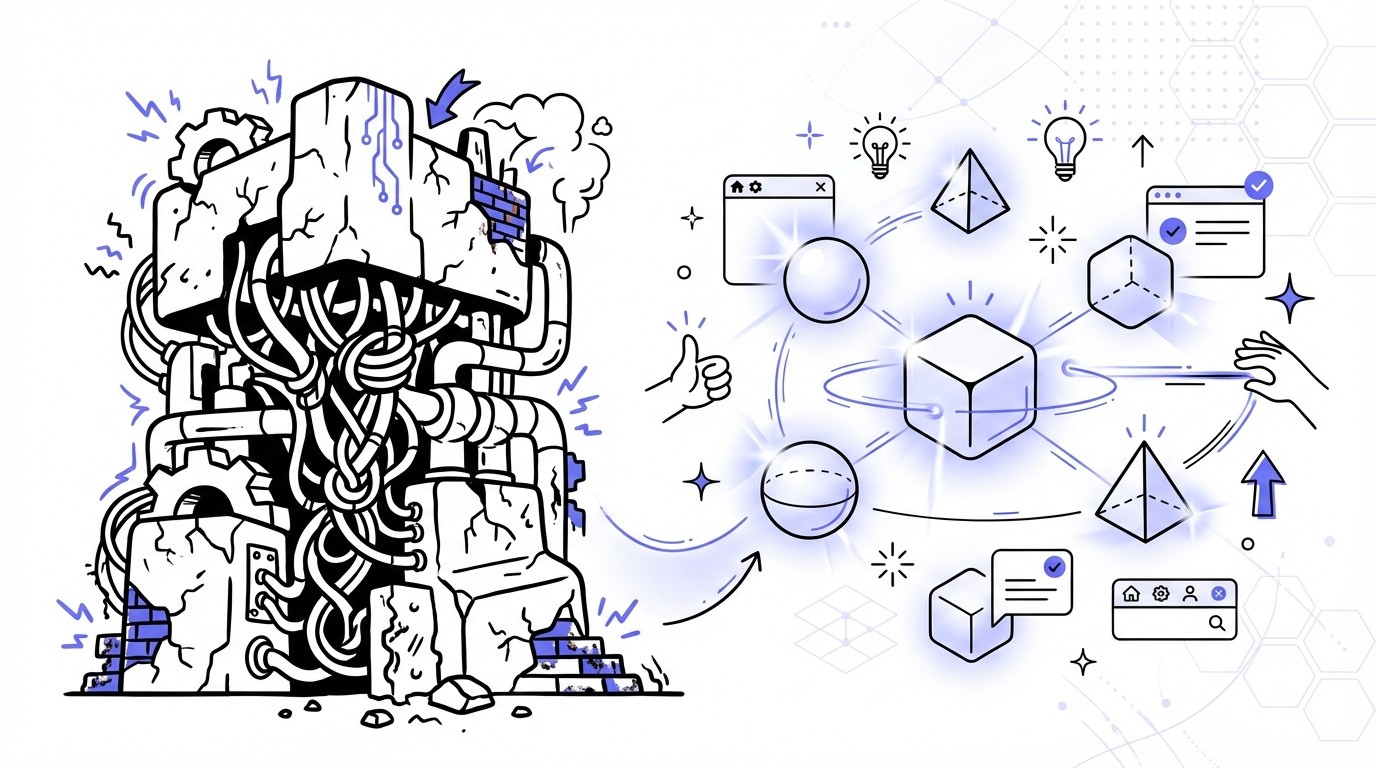
From tangled legacy to agile innovation: A visual journey depicting the evolution from monolithic complexity to the streamlined efficiency of modern, cloud-native architectures.
Core Components of a Modern AI Startup Tech Stack
Your architectural decisions today must anticipate the AI of tomorrow. A modern startup tech stack built in 2023 can feel dated by 2025. Successful founders build for where the industry is going, not where it has been. This means designing for autonomous agentic systems and using serverless AI computing as the standard for AI workloads. An effective startup tech stack is a flexible system built from best-in-class components, often leveraging specialized AI development tools.
Foundational Models and Serverless AI Compute
Your first decision is how to access AI intelligence. Instead of training a model from scratch, you can use powerful Foundational Models via an API. This gives you instant access to capabilities like those from Gemini AI. The key is running these models efficiently.
A serverless AI approach is the solution. It lets you execute code in response to triggers without managing servers. You pay only for the compute time you consume. For AI startups with sporadic workloads, this is critical. AWS estimates that using serverless AI for inference can reduce Total Cost of Ownership by up to 70% compared to provisioned servers.
Specialized Data Stores for AI-Native Architectures
Standard databases can't handle the unique data needs of AI. Your models require specialized stores to manage context, memory, and features. Choosing the right database for the right job prevents major bottlenecks as you scale. These are crucial components of an efficient AI-native architecture and a robust startup tech stack.
Data Store TypePrimary Use CaseWhy It's Critical for AIExample ToolsRelational DatabaseStoring structured application data (e.g., user accounts)Manages core business data reliably.PostgreSQL, MySQLVector DatabaseSemantic search and long-term memory for agentsLets AI find information based on conceptual meaning.Pinecone, WeaviateFeature StoreStoring and serving ML features for training/inferenceEnsures data consistency between experiments and production.Tecton, Feast
Orchestration Frameworks: AI Development Tools for Agentic Systems
Finally, you need a way to coordinate complex AI tasks. This is where agentic systems come to life. Orchestration frameworks are the AI development tools that act as the brain for your agents. They connect your language models, data stores, and other APIs into a cohesive workflow. Frameworks like LangChain or LlamaIndex provide the structure to build agentic systems that can reason, plan, and execute multi-step goals.
When choosing a framework, ask these key questions: These AI development tools are central to your success in building sophisticated agentic systems.
Complexity vs. Control: Do you need a high-level, abstracted framework (like LangChain), or granular control over data chunking and indexing (like LlamaIndex)?
Ecosystem & Integrations: Which framework better supports the specific data sources, models, and APIs you plan to use?
Observability: How easily can you debug and trace the multi-step reasoning of your agent within the framework?
Strategic Considerations for Your AI Startup Tech Stack
The right components are just the start. Your technology choices directly impact your company's financial health and team structure. A well-designed startup tech stack is a strategic asset, not just a line item on a budget. It's the engine for your AI development.
Balancing Cost, Speed, and Scalability with Serverless AI
Early-stage startups live or die by their burn rate. A traditional, server-heavy infrastructure requires significant upfront investment and consumes cash even when idle. Over 80% of startups fail because of cash flow problems, a risk magnified by fixed infrastructure costs.
A serverless AI architecture flips this model. You pay for compute by the millisecond, aligning costs directly with customer usage. This approach lets you scale from zero to millions of users without re-architecting your core. It protects your runway for product development and market entry. This makes serverless AI a cornerstone of a modern startup tech stack for AI-driven applications.
Building an AI-Native Architecture for Agility, Not Dependency
Relying on a single foundational model is a major risk. What if your provider raises prices, changes its API, or falls behind a competitor? A truly modern AI native architecture is built for agility. You should design your system to be model-agnostic. This means creating an internal layer that can route requests to different models based on cost, performance, or the specific task. This approach defines a resilient startup tech stack.
This strategy transforms a potential weakness into a competitive advantage.
ConsiderationSingle-Model DependencyAgnostic ArchitectureFlexibilityLocked into one provider's roadmap and limitations.Can use the best model for each specific task.Cost ControlSubject to a single vendor's pricing changes.Routes jobs to the most cost-effective model.ResilienceA provider outage can shut down your product.Can failover to a secondary model instantly.
This composable approach ensures you always have access to the best technology. You're not just building a product; you're building a resilient system that can adapt to a rapidly changing AI landscape.
Future-Proofing Your AI Stack: Embracing Agentic & Composable Systems
Your technology choices today dictate your company's potential tomorrow. A model-agnostic approach provides resilience. True future-proofing requires a deeper architectural shift. You need a system that can not only swap models but also reconfigure entire workflows on the fly. This is the essence of a composable and agentic startup tech stack, ready for the future of AI development.
A composable AI native architecture treats every component as an interchangeable building block. Think of your foundational models, databases, and APIs as LEGOs. You can connect them in new ways to create novel capabilities without rebuilding your entire product.
Building Autonomous, Goal-Oriented Agentic Systems
Agentic systems represent the next evolution of AI applications. They move beyond simple, one-shot tasks. Instead, these systems use AI development tools and orchestration frameworks to reason, plan, and execute complex goals. An agent can autonomously use different tools to solve a problem.
An Agentic Workflow in Action:
Imagine a user asks your app to "Analyze our top three competitors and suggest marketing angles." The agent would:
Plan: Break the goal into steps: identify competitors, find their marketing materials, analyze them, and synthesize suggestions.
Use Tools: Query a search API to find the competitors, then use a web scraping tool to gather data from their websites.
Reason: Pass the collected data to an LLM to analyze sentiment and messaging.
Synthesize: Combine the insights into a final report for the user.
This approach transforms your product from a passive tool into an active partner. A 2023 report from Sequoia Capital suggests agentic AI workflows can automate up to 80% of tasks for knowledge workers, creating massive efficiency gains.
CapabilityTraditional AI ApplicationComposable, Agentic SystemTask ExecutionFollows a rigid, pre-defined workflow.Dynamically plans and executes steps to achieve a goal.AdaptabilityRequires engineering to add new tools.Can integrate new APIs or data sources as "tools" instantly.ScalabilityMonolithic code is difficult to scale or modify.Individual microservices and functions scale independently.Innovation SpeedSlow; new features require deep architectural changes.Fast; new products are assembled from existing components.
Adopting this forward-looking AI-native architecture is a strategic decision. It ensures your startup can adapt as the AI landscape continues its rapid change. You're not just building for the models of today; you're building a system ready for the breakthroughs of tomorrow.
Building your startup tech stack is building your business strategy. Every choice, from your cloud provider to your adoption of agentic frameworks, directly shapes your capacity for innovation. A well-designed startup tech stack isn't a cost center; it's your primary competitive advantage for AI development.
An optimized, AI-native architecture foundation allows your team to focus on your core product. This approach doesn't just conserve engineering resources. It builds a resilient company where technology acts as a force multiplier. Your first architectural meeting should focus less on specific tools and more on the model-agnostic, agentic design that will define your future, leveraging the best AI development tools available for your startup tech stack.
Your tech stack needs a powerful content engine. See how MarketDay's AI automates your entire blog creation process and start your free trial to publish your first SEO-optimized article in minutes.
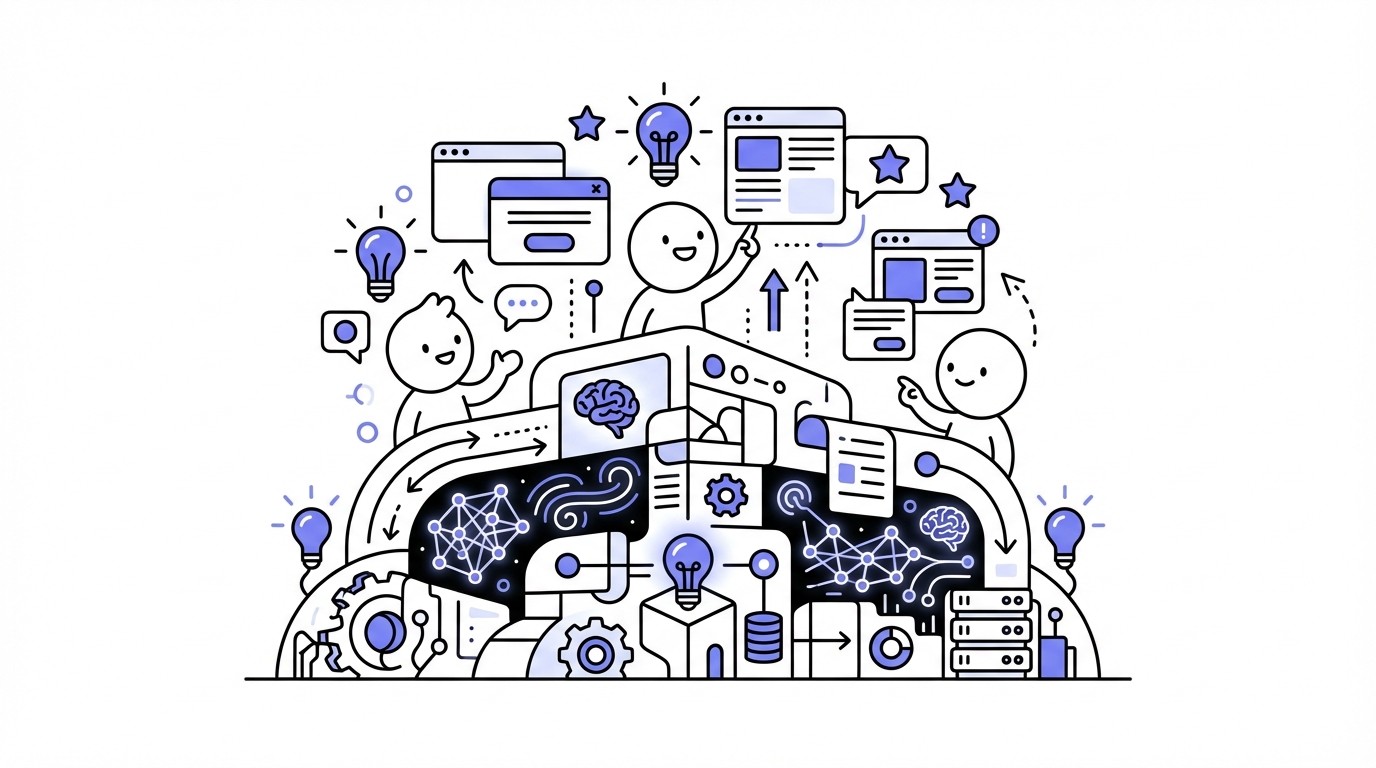
Building innovation from the ground up: The power of an AI-native tech stack as your foundational strength.
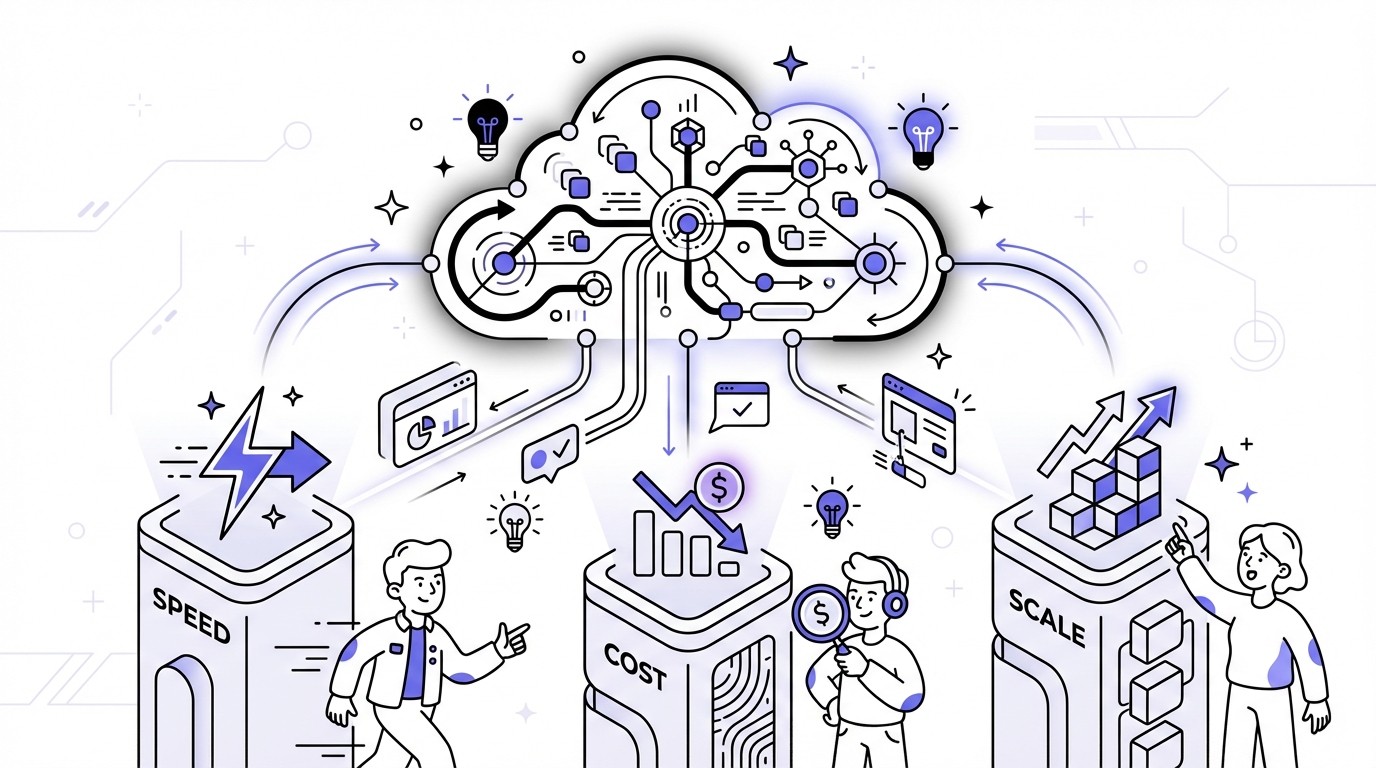
Understanding AI-Native Architecture: Built on the foundational pillars of Speed, Optimized Cost, and Scalability for peak performance.
Visuals
Frequently Asked Questions
What is an AI-native architecture for a startup tech stack?
An AI-native architecture is a modern startup tech stack specifically designed for AI companies, prioritizing speed, cost efficiency, and scalability. Unlike traditional monolithic systems, it leverages composable microservices and serverless AI principles. This approach allows AI startups to focus on building intelligence rather than managing infrastructure, making it a competitive advantage.
Why is an AI-native architecture crucial for an AI startup tech stack?
An AI-native architecture is vital because it forms the product's foundation, directly impacting model performance and development speed for an AI startup tech stack. It prevents the competitive disadvantage of managing complex infrastructure, enabling rapid iteration and cost control. This specialized approach ensures the stack supports complex computations and data processing inherent to AI.
How does serverless AI benefit a startup tech stack?
Serverless AI significantly benefits a startup tech stack by reducing infrastructure costs and increasing efficiency. It allows execution of AI workloads, like model inference, without managing servers, paying only for compute time consumed. This approach can reduce Total Cost of Ownership by up to 70%, crucial for AI startups with fluctuating or sporadic workloads.
What are agentic systems and why are they important for AI development?
Agentic systems are autonomous AI entities designed to perform tasks, make decisions, and interact with environments independently. They are crucial for modern AI development tools as they represent the future of AI applications, enabling more sophisticated and intelligent automation. Building for these systems ensures a future-proof AI-native architecture.
What are the key pillars of an effective AI-native architecture?
The key pillars of an effective AI-native architecture are speed to iterate, cost efficiency, and scalability for growth. This modern approach enables rapid experimentation in a fast-changing AI landscape, optimizes compute expenses through models like serverless AI, and ensures the system can handle both model training and user inference without bottlenecks.
Which specialized data stores are essential for an AI-native architecture?
For an efficient AI-native architecture, specialized data stores are critical beyond traditional databases. Vector databases are essential for semantic search and long-term memory for AI agents. Distributed data lakes also play a vital role in managing the unique, often unstructured, data needs of AI models, preventing performance bottlenecks as the system scales.
How do AI development tools support building a modern AI startup tech stack?
AI development tools are indispensable for building a modern AI startup tech stack by streamlining MLOps practices and enabling rapid model deployment. They provide frameworks, libraries, and platforms that accelerate the development, training, and deployment of AI models. These tools allow founders to focus on innovation rather than infrastructure management, enhancing competitive advantage.


Hop on a call with us to see how our services can accelerate your growth.