AEO vs SEO vs GEO: Complete Guide to AI-Driven Brand Visibility

K R
Days AI
MarketDay
An AI-powered content and visibility platform that helps teams create authoritative content and get discovered across Google and modern AI platforms like ChatGPT, Claude, Perplexity, and more.

AEO vs SEO vs GEO: Complete Guide to AI-Driven Brand Visibility
Your customers aren't just searching anymore. They're having conversations with search engines. The rise of Google's AI Overviews and conversational AI tools means the classic blue links are no longer the only goal. For brands trying to maintain their digital visibility AI, this fundamental shift presents a new challenge.
The visibility you built with traditional SEO is now just one piece of a much larger puzzle. An effective AI search strategy now requires understanding three distinct disciplines: Answer Engine Optimization (AEO), Search Engine Optimization (SEO), and Generative Engine Optimization (GEO). We'll clarify the AEO vs SEO vs GEO debate and show you how each strategy works. This comprehensive approach is crucial for modern Generative AI marketing. You'll see how they connect and learn which approach will best secure your brand's authority.
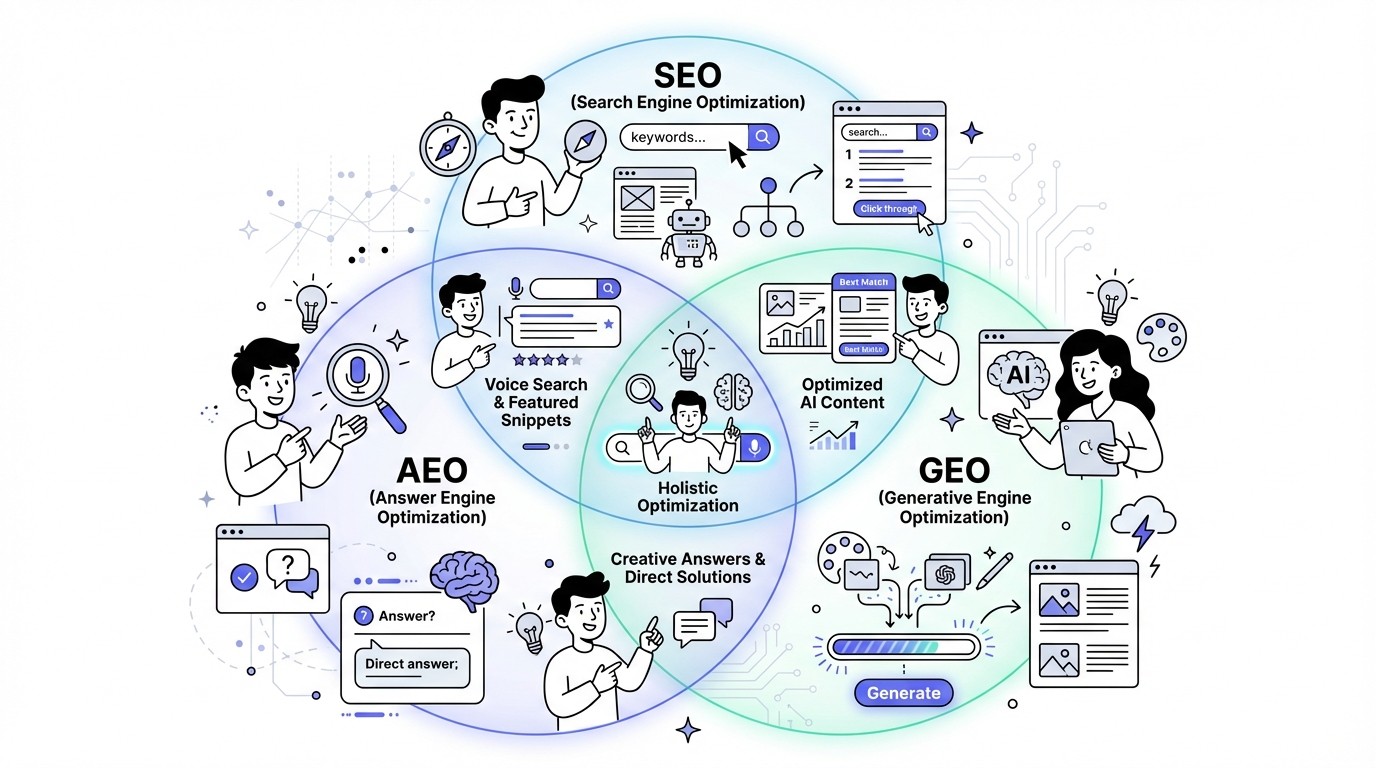
Navigating the digital landscape: A visual comparison of AEO, SEO, and GEO, highlighting their distinct roles and interconnected strategies for modern online visibility.
SEO: The Foundation of Digital Visibility in the AI Era
Search Engine Optimization (SEO) is the non-negotiable bedrock of any digital strategy. It’s the practice of structuring your website and content so search engines can find, understand, and rank it. While new AI-driven search experiences are emerging, they all rely on the same source material: well-indexed, high-quality web pages.
Think of it this way: you can't win a race if you're not at the starting line. SEO gets you there. Strong organic search performance remains critical. Organic search still drives over 53% of all website traffic, making it the largest single source for most businesses. This is the core of your digital visibility AI efforts.
How AI Has Reshaped SEO Priorities
The principles of SEO haven't been replaced by AI; they've been refined. The focus has shifted from simple keyword matching to demonstrating deep expertise and satisfying user intent. An effective AI search strategy recognizes this evolution. AI algorithms now prioritize signals of quality and trustworthiness more than ever before. This refined approach to SEO is vital for any successful Generative AI marketing campaign.
This table shows the shift in focus:
SEO ElementTraditional Focus (Pre-AI)Modern Focus (AI-Era)KeywordsExact keyword density and placementTopic clusters and semantic relevanceContentVolume and keyword frequencyE-E-A-T (Experience, Expertise, Authoritativeness, Trust)TechnicalBasic meta tags and sitemapsStructured data (Schema), Core Web Vitals, mobile-first indexingBacklinksQuantity of links from any sourceQuality and contextual relevance of referring domains
To align with modern SEO, start by developing topic clusters instead of targeting single keywords. Audit your content for E-E-A-T signals by adding author bios with credentials and citing reputable sources. Finally, implement advanced Schema markup to clearly define entities on your site, helping AI understand your content's context and trustworthiness, a key component of your overall AI search strategy.
Insights into cloud technology adoption: A visual breakdown of organizational engagement.

SEO: The essential bedrock for building a strong, visible presence in the digital world.
AEO: Mastering Answer Engine Optimization for AI Search
While SEO gets your page ranked, Answer Engine Optimization (AEO) aims for a higher prize. AEO focuses on making your content the direct source for AI-generated summaries and voice search results. Simply appearing on the list of blue links is no longer enough. Your goal is to be the answer.
This shift is driven by user behavior. People want immediate, concise information. A 2024 study from BrightEdge revealed that AI Overviews now appear in over 84% of search queries, fundamentally altering how users get information. Your AI search strategy must adapt to this reality. This focus on direct answers is a cornerstone of modern digital visibility AI.
The Strategic Shift from Ranking to Answering
AEO is not a replacement for SEO; it’s a specific discipline built on top of it. You need a strong SEO foundation for Answer Engine Optimization to work effectively. The core difference lies in the ultimate objective.
This table clarifies the distinction:
AspectSearch Engine Optimization (SEO)Answer Engine Optimization (AEO)Primary GoalRank a URL in the top 10 search results.Become the cited source in an AI-generated answer.Content FocusComprehensive, long-form content covering a topic.Clear, factual, and concisely written answers to specific questions.Key TacticsKeyword research, link building, on-page optimization.Structured data (FAQ Schema), Q&A formatting, entity building.User OutcomeThe user clicks a link to find an answer on your site.The user gets the answer directly on the search results page.
To start optimizing for answers, focus on these tactical steps:
Implement FAQPage Schema: Use structured data to mark up question-and-answer sections on your pages. This explicitly tells search engines what questions your content answers.
Use Q&A Formatting: Structure content with clear headings (H2s, H3s) phrased as common user questions. Follow each heading with a direct, concise answer (40-60 words) before elaborating.
Build Topical Authority: Create clusters of content around a core topic. This establishes your site as an expert, making it a more trustworthy source for AI to cite.
These tactics are crucial for any brand aiming for leadership in Answer Engine Optimization and a robust AI search strategy.
GEO: Local Relevance in a Global AI Landscape
Geographic Optimization (GEO) ensures your content is relevant to a user's physical location. Even for a global software company, where a user is searching from provides critical context. Ignoring this layer means missing a huge piece of the puzzle. After all, 46% of all Google searches are for local information.
GEO adds the "where" to your SEO and AEO strategy. It’s not just about brick-and-mortar stores. For a B2B brand, it means understanding that a potential customer in London has different business needs than one in Silicon Valley. A comprehensive AI search strategy must account for these regional nuances. For effective Generative AI marketing, understanding local context is paramount.
How AI Enhances Geographic Targeting
AI models now infer local intent without explicit keywords like "near me." They analyze user behavior and real-time data to deliver geographically relevant results. This allows for a more sophisticated approach than simply targeting city names. Your platform's digital visibility AI depends on this hyper-personalization. This sophisticated approach is essential for a complete AI search strategy.
The table below shows how AI has evolved geographic optimization:
AspectTraditional Local SEOAI-Driven GEOTargetingExplicit city names and zip codesInferred user location and regional business hubsSignalsGoogle Business Profile, static citationsReal-time user context, device data, local eventsContentStandardized, location-specific landing pagesContent adapted to regional market trends and regulations
By integrating GEO, you ensure the right answer reaches the right person in the right context. It completes the picture, turning broad authority into specific, localized relevance that drives action.
The Interplay: How SEO, AEO, and GEO Create a Holistic AI Strategy
SEO, AEO, and GEO are not competing priorities. They are three essential layers of a single, powerful AI search strategy. A weakness in one area undermines the others. A winning approach integrates them to create a search presence that is authoritative, direct, and contextually aware. We'll explore how mastering AEO vs SEO vs GEO collaboratively leads to unparalleled digital presence.
Think of it as a pyramid. SEO forms the broad, stable base. AEO builds on that foundation to become the sharp, visible peak. GEO ensures the entire structure is relevant to the local landscape. You need all three to dominate modern search.
A Unified Framework for Digital Visibility
These disciplines create a powerful feedback loop.
SEO enables AEO: AI models are more likely to pull answers from websites that are technically sound and well-structured.
AEO enhances SEO: Securing a spot in an AI Overview builds brand authority, which can lead to higher organic rankings.
GEO personalizes both: It adapts your content to local needs, making your answers more relevant and effective.
This level of personalization is no longer optional. A McKinsey report found that 71% of consumers expect personalized interactions from companies. For a Generative AI marketing platform, this means an answer must account for regional business customs to be truly useful. Understanding the nuances of AEO vs SEO vs GEO is critical for this unified approach.
The table below shows how these components work together.
ComponentCore FunctionContribution to AI StrategySEOBuilds foundational authority and visibility.Ensures content is discoverable and technically sound for AI crawlers.AEODelivers direct, concise answers.Positions your brand as the definitive source in AI-generated results.GEOProvides location-based context.Customizes answers for regional markets, improving user trust and conversion.
SEO, AEO, and GEO are no longer separate disciplines. They form a single strategy for digital authority. Your success in an AI-first search landscape depends on mastering all three. Search engines now reward content that answers questions directly (Answer Engine Optimization), ranks in traditional results (SEO), and meets local user intent (GEO). This holistic perspective on AEO vs SEO vs GEO is the future of digital visibility AI.
Building this unified presence manually is a significant challenge. It requires an intelligent, scalable approach to content—the exact problem we built MarketDay to solve. The future of visibility isn't about chasing one acronym. It’s about building a comprehensive digital footprint that intelligent search algorithms will consistently favor, optimizing for AEO vs SEO vs GEO to achieve superior digital visibility AI.
Ready to conquer AEO, SEO, and GEO without the manual work? See how MarketDay uses AI to automatically research, write, and optimize high-ranking blog posts in minutes for your Generative AI marketing needs.
Visuals
Frequently Asked Questions
Why is understanding AEO, SEO, and GEO crucial for modern Generative AI marketing?
Understanding AEO, SEO, and GEO is crucial because customer search behavior has evolved from simple queries to conversational interactions with AI. An effective Generative AI marketing strategy requires optimizing for traditional search rankings, direct AI answers, and generative AI outputs to maintain comprehensive digital visibility AI and brand authority in this new landscape.
How has AI reshaped SEO priorities, and how does this impact the AEO vs SEO vs GEO landscape?
AI has shifted SEO priorities from exact keyword matching to demonstrating deep expertise (E-E-A-T), topic clusters, and structured data. This refinement means strong SEO is the foundation upon which Answer Engine Optimization (AEO) and Generative Engine Optimization (GEO) are built, impacting the entire AEO vs SEO vs GEO approach by emphasizing quality and context.
What is Answer Engine Optimization (AEO) and how does it build upon SEO?
Answer Engine Optimization (AEO) focuses on making your content the direct source for AI-generated summaries and voice search results, aiming to be the answer rather than just a ranked link. It builds upon a strong SEO foundation, as AI still relies on well-indexed, high-quality web pages to extract its answers, making it a key part of any AI search strategy.
Which modern SEO practices are essential for digital visibility in the AI era?
Essential modern SEO practices include developing topic clusters for semantic relevance, auditing content for E-E-A-T signals (Experience, Expertise, Authoritativeness, Trust), and implementing advanced Schema markup. These strategies help AI algorithms understand your content's context and trustworthiness, crucial for maintaining strong digital visibility AI.
What is the primary goal of Answer Engine Optimization (AEO) in an AI search strategy?
The primary goal of Answer Engine Optimization (AEO) is to ensure your content is chosen as the direct, concise answer provided by AI overviews and voice search. This goes beyond traditional ranking, aiming for your brand to be the authoritative source cited by AI, a key component of a successful AI search strategy to enhance digital visibility AI.
How do AEO, SEO, and GEO collectively contribute to a winning AI search strategy for digital visibility?
AEO, SEO, and GEO collectively form a comprehensive AI search strategy. SEO establishes the foundational visibility, AEO ensures your content is directly answered by AI, and GEO optimizes for generative AI outputs. Together, they maximize your brand's presence across all AI-driven search experiences, securing robust digital visibility AI in the modern landscape.



Hop on a call with us to see how our services can accelerate your growth.