AI Content Platforms vs. Traditional SEO Tools: What Works for SEO

K R
Days AI
MarketDay
An AI-powered content and visibility platform that helps teams create authoritative content and get discovered across Google and modern AI platforms like ChatGPT, Claude, Perplexity, and more.

AI Content Platforms vs. Traditional SEO Tools: What Works for SEO
The search landscape is changing. Fast. Google's AI Overviews now answer queries directly, fundamentally altering how users interact with search results. Brands are seeing their organic traffic change unpredictably. This new reality forces a difficult question for marketing leaders: Is it time to abandon trusted, traditional SEO tools for automated AI content platforms?
That’s the wrong question. The future of search visibility isn’t a battle; it’s a strategic division of labor. Winning in SEO 2026 requires fusing human-led strategy with machine-led execution. You still need the deep analytical power of classic SEO tools to define the mission. But you need the intelligent automation of AI content platforms to achieve it at scale. This guide outlines that new workflow, showing how to drive growth in an AI-first world, navigating the path to AI search dominance.
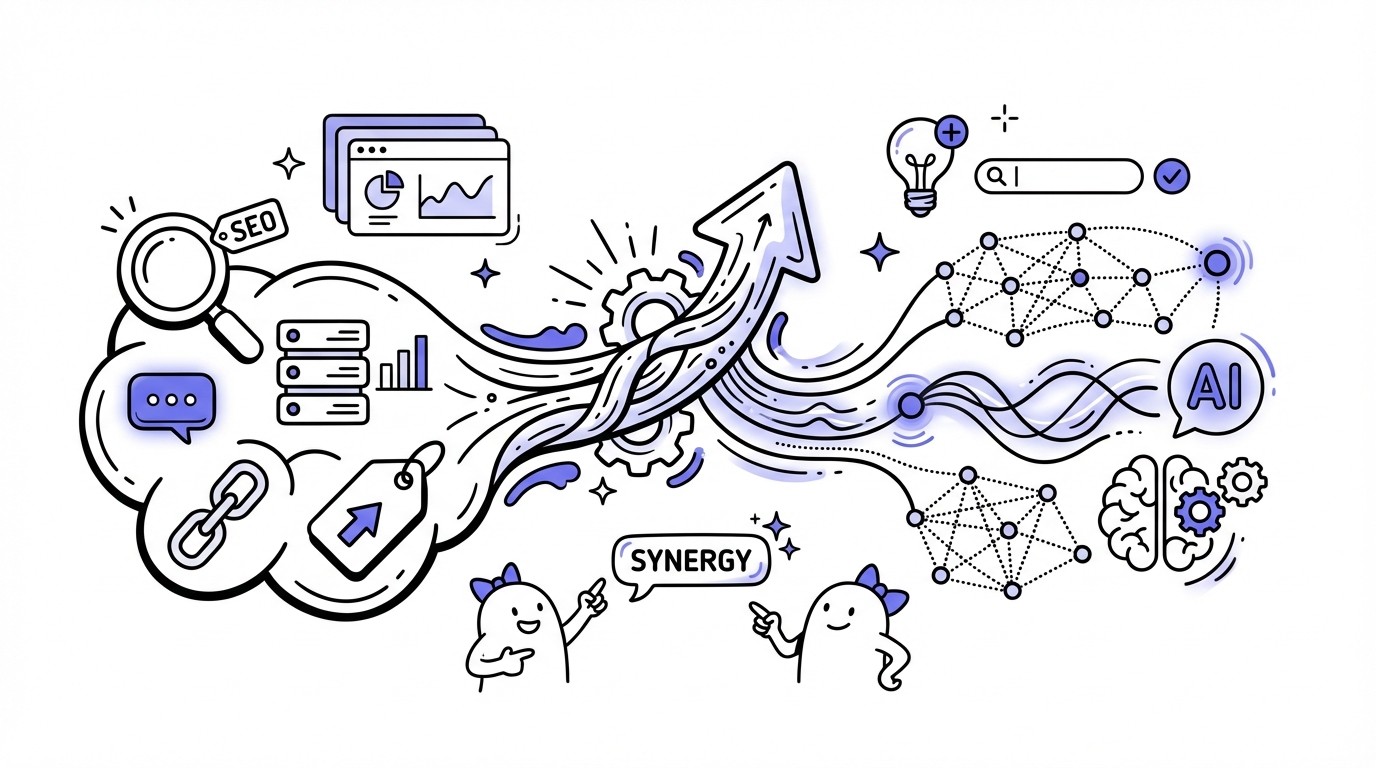
Embracing the future of SEO: A powerful hybrid approach where traditional insights meet the advanced intelligence of AI for unparalleled optimization and growth.
The Rise of AI-First Search: Google AI Overviews & AI Search Dominance
Google's AI Overviews are rapidly changing the search results page. Users now get direct answers, often eliminating the need to click through to a website. This accelerates the trend toward a zero-click reality. Your content must do more than rank; it has to become the authoritative source for Google's AI, a crucial step for success in SEO 2026.
This isn't a future prediction. It's happening now. A recent Raptive study found that some publishers saw traffic drop by an average of 25% following the full rollout of Google AI Overviews. This data signals a critical shift. The old playbook is obsolete for SEO in 2026. Your strategy must focus on informational influence, not just clicks, to achieve AI search dominance.
The objective has changed. Success is no longer just about driving a click. It’s about being the trusted source cited within the AI-generated answer itself, a critical goal given the prominence of Google AI Overviews. This requires a new approach to content and tooling, moving beyond the limitations of traditional SEO tools.
MetricTraditional SERP RankingAI Overview InclusionPrimary GoalDrive a click to your websiteBecome the cited source in the AI answerKey Content TraitComprehensive, long-formFactual, concise, highly structuredSuccess MetricOrganic Clicks, CTRBrand mentions, "Cited in AI" visibilityTool FocusKeyword research, backlink analysisRAG-ready content generation (via AI content platforms)
This new landscape clearly shows the limits of traditional SEO tools. While excellent for finding opportunities and analyzing competitors, helping you find the right questions to answer, they weren't built for the machine-readable content needed for AI search dominance. That’s the gap AI content platforms now fill, providing essential capabilities for SEO in 2026.
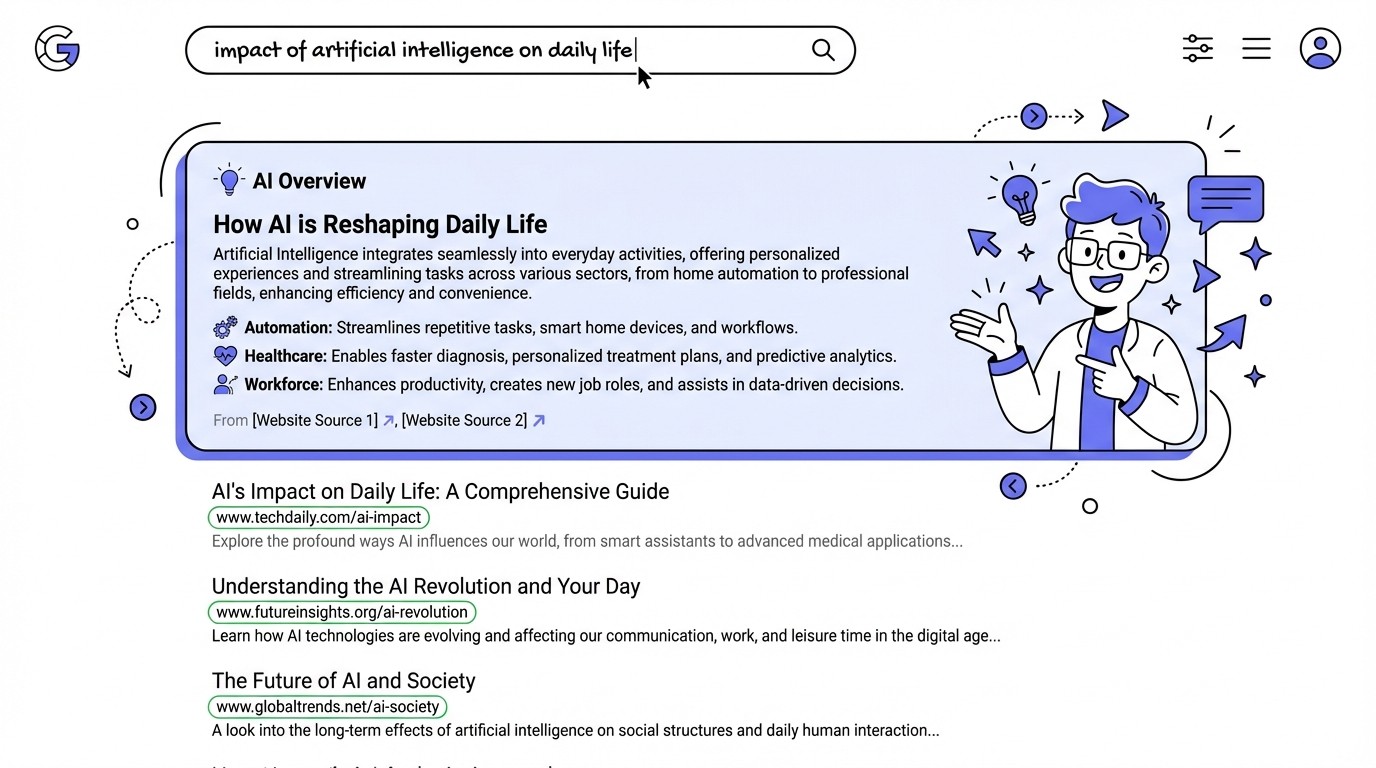
The future of search: AI Overviews are taking center stage, transforming how we find information.
Traditional SEO Tools: Their Evolving Role in an AI World
Traditional SEO tools are not becoming obsolete; their job is simply changing. They are shifting from all-in-one solutions to pure strategic instruments. These established SEO tools provide the essential 'why' and 'where' before an AI content platform handles the 'how'. This strategic division is vital for navigating the complexities of SEO 2026.
This approach ensures your AI-powered content strategy is grounded in solid data, not guesswork. Human-led analysis, supported by traditional SEO tools, remains critical for setting the right direction and achieving AI search dominance.
Traditional SEO Tools: Strategic Intelligence for AI Content Platforms
Think of traditional SEO tools like Ahrefs or Semrush as your strategic intelligence unit. They deliver the critical mission briefings—on keyword opportunities, competitive threats, and performance data. This intelligence guides your AI content platforms' execution. Their core strengths now serve as the guardrails for your content operations, ensuring your AI-generated content is always on target for Google AI Overviews.
Their evolving responsibilities include:
Opportunity Analysis: These traditional SEO tools excel at uncovering high-intent keyword clusters and competitive gaps. An analysis might reveal an opportunity around "best budget SaaS for small business," signaling clear commercial intent that guides the AI content platform's focus.
Competitive Intelligence: You still need to analyze a competitor’s domain authority and top-performing pages. This data provides a clear blueprint that informs your AI-driven content calendar, optimized for SEO 2026.
Performance Validation: After an AI content platform like MarketDay publishes an article, these traditional SEO tools are your scorecard. They track keyword rankings and organic traffic to measure the real-world impact of your strategy, especially concerning visibility in Google AI Overviews.
The function of these traditional SEO tools has become more focused and strategic. They provide the data-backed direction needed for AI content platforms to generate content that actually performs, driving AI search dominance.
SEO FunctionTraditional Role (Pre-AI)Evolving Role (with AI)Keyword ResearchFind keywords, then manually write.Identify strategic topics for AI content platforms to target.Content BriefsManually build detailed outlines.Define high-level goals and constraints for AI content platforms.Rank TrackingMeasure success of manual content.Validate the performance of AI-generated assets, crucial for SEO 2026.
This division of labor is the key to success for SEO in 2026. Your team uses traditional SEO tools to define the strategy. An intelligent AI content platform then executes that strategy with precision and speed, ensuring your content is optimized for Google AI Overviews and overall AI search dominance.
AI Content Platforms: Powering SEO 2026 & AI Search Dominance
If traditional SEO tools provide the intelligence, AI content platforms are the execution engine. They execute your strategy at an impossible scale. These advanced platforms don't just write faster; they create content structured for an AI-first search world. This is the critical link between your goals and ranking in SEO 2026, especially for securing visibility in Google AI Overviews.
AI content platforms like MarketDay are designed to close the gap between data-driven strategy and high-volume content production. They take the keyword opportunities and competitive insights you've found using traditional SEO tools and turn them into optimized articles ready for publication, designed for AI search dominance.
AI Content Platforms: From Human Strategy to Machine Execution
The core function of an AI content platform is to automate the most time-consuming parts of the content lifecycle. A human strategist still sets the direction, informed by traditional SEO tools. The AI then handles the heavy lifting with a focus on what performs in the age of AI search dominance and the era of Google AI Overviews.
This approach delivers several key advantages for SEO in 2026:
Unmatched Scale: A typical content team might produce 5-10 high-quality articles per month. An AI content platform can generate that same volume in a single afternoon, allowing you to target niche long-tail keywords consistently and achieve broader AI search dominance.
Structured for AI Consumption: The content isn't just readable for humans. It's built with the clear, factual structure that models like Google's Gemini need to generate Google AI Overviews. This dramatically increases your chances of being a cited source, a key metric for SEO 2026.
Factual Accuracy with RAG: Modern AI content platforms use Retrieval Augmented Generation (RAG). They connect directly to your company's internal knowledge base. This ensures every article is infused with your unique data, case studies, and brand voice, establishing true authority and trustworthiness for Google AI Overviews.
The workflow is different. It shifts your team from manual writing to strategic oversight, leveraging the power of AI content platforms. That's a much better use of their expertise in the pursuit of AI search dominance.
TaskTraditional Manual WorkflowAI Content Platform WorkflowOutline Creation1-2 hours of manual structuring.Instant generation based on SERP analysis by AI content platforms.First Draft4-8 hours of writing and research.5 minutes to generate a full draft.SEO OptimizationManual keyword placement, meta tags.Automatic, integrated into the writing process for SEO 2026.Image Sourcing30 minutes finding stock photos.Instant generation of relevant, unique images by AI content platforms.Total Time6 - 11 hours per article~20 minutes per article
This new model doesn't replace your content team. It gives them superpowers. They can now manage a content program that's 10x larger without sacrificing quality, directly addressing the demands of SEO in 2026 and the need for AI search dominance.
Integrating AI Content Platforms & Traditional SEO Tools for SEO 2026 Success
Choosing between AI content platforms and traditional SEO tools is the wrong question for SEO in 2026. Success no longer comes from picking a side. It comes from creating a closed-loop system where each tool enhances the other. This integrated strategy, combining the strengths of traditional SEO tools with the efficiency of AI content platforms, is the key to dominating an AI-driven search landscape and securing visibility in Google AI Overviews.
The best content programs combine human strategy with machine execution. Your team uses traditional SEO tools to define the mission. An AI content platform then gets you there faster and more efficiently, driving AI search dominance.
A Modern SEO Workflow for AI-First Content Strategy and AI Search Dominance
This new workflow is straightforward and powerful. It turns a linear, manual process into a continuous cycle of insight, creation, and validation, essential for SEO 2026.
Strategize with Data: Your SEO analyst uses a traditional SEO tool like Semrush to identify a high-value keyword cluster—for example, "AI for sales automation." They analyze top competitors and find a specific content gap, informing the strategy for AI content platforms.
Execute with AI: This strategic brief is fed into an AI content platform like MarketDay. The platform instantly generates a series of articles covering every facet of the topic, from beginner guides to expert comparisons. Each piece is structured to feed Google AI Overviews, aiming for AI search dominance.
Validate and Refine: Once the content is live, your team uses traditional SEO tools like Semrush again to track keyword rankings and organic traffic. This performance data provides new insights, which fuel the next round of strategic planning for SEO in 2026.
This cycle allows you to scale your content operations without sacrificing strategic direction. Your team focuses on high-level analysis using traditional SEO tools, while the AI content platform handles the repetitive, time-consuming production work, optimizing for Google AI Overviews.
StageActionPrimary Tool TypeOutcome1. StrategyIdentify keyword gaps and competitor weaknesses.Traditional SEO ToolA data-backed content plan for AI content platforms.2. ExecutionGenerate dozens of optimized articles and images.AI Content PlatformHigh-volume, quality content published in hours, targeting Google AI Overviews.3. ValidationTrack rankings and measure business impact.Traditional SEO ToolProof of performance and insights for the next cycle, crucial for SEO 2026.
This integrated model transforms your SEO function. Your team shifts from manual labor to strategic oversight. They become the architects of a content engine, not just writers. That’s how you win in the era of AI search dominance and secure your position for SEO 2026.
This symbiotic strategy is no longer optional. It's the blueprint for market leadership. You win by pairing human intelligence with machine execution. Use traditional SEO tools to pinpoint the opportunity. Then deploy an AI content platform like MarketDay to capture it at scale, ensuring your content is optimized for Google AI Overviews. That’s how you build a content engine that dominates in SEO 2026 and the era of AI search dominance.
Your strategy is set. It's time to execute. See how MarketDay turns your SEO insights into high-performance content that wins in an AI-first world, ensuring AI search dominance for your brand. [Request a Demo]
Visuals
Frequently Asked Questions
What is the main shift in SEO for 2026 with Google AI Overviews?
The primary shift in SEO 2026 is moving from solely driving clicks to becoming the authoritative source cited directly within Google AI Overviews. Users now receive direct answers, making it crucial for content to be machine-readable and influential for AI. This fundamentally alters how brands achieve visibility and organic traffic.
How are Google AI Overviews changing the landscape for AI search dominance?
Google AI Overviews are transforming search by providing direct answers, often eliminating the need for users to click through to websites. This accelerates a zero-click reality, meaning content must be structured to be consumed and cited by AI. Achieving AI search dominance now depends on being the trusted source for these AI-generated summaries.
Why are traditional SEO tools still essential in SEO 2026?
Traditional SEO tools remain essential in SEO 2026 because their role has evolved to strategic intelligence. They provide the 'why' and 'where' for content strategy, uncovering keyword opportunities, competitive insights, and performance validation. This human-led analysis guides the execution of AI content platforms, ensuring a data-driven approach.
What distinguishes AI content platforms from traditional SEO tools?
AI content platforms are designed for machine-led execution, generating content at scale that is optimized for AI consumption. In contrast, traditional SEO tools provide strategic intelligence, focusing on keyword research, competitive analysis, and performance tracking. The future of search visibility requires a hybrid approach, leveraging both for optimal results.
What is the new objective for achieving AI search dominance?
The new objective for achieving AI search dominance is to be the trusted source cited within Google's AI-generated answers, rather than just driving a click. This requires content to be factual, concise, and highly structured, making it easily digestible and attributable by AI systems. Success is measured by informational influence and brand mentions.
How can brands achieve success in SEO 2026 amidst Google AI Overviews?
Brands can achieve success in SEO 2026 by adopting a hybrid strategy that fuses human-led insights with machine-led execution. This means using traditional SEO tools for strategic analysis and opportunity identification, while leveraging AI content platforms to create and optimize content at scale for Google AI Overviews. This ensures content is both strategic and AI-ready.
What specific responsibilities do traditional SEO tools now handle in an AI-first world?
In an AI-first world, traditional SEO tools primarily handle strategic intelligence. Their responsibilities include opportunity analysis, identifying high-intent keyword clusters and competitive gaps. They also provide competitive intelligence by analyzing competitor domains and top-performing pages, and performance validation by tracking keyword rankings and organic traffic for content generated by AI content platforms.



Hop on a call with us to see how our services can accelerate your growth.