AI Search Engines: Make Your Blog Visible & Boost Traffic

K R
Days AI
MarketDay
An AI-powered content and visibility platform that helps teams create authoritative content and get discovered across Google and modern AI platforms like ChatGPT, Claude, Perplexity, and more.

AI Search Engines: Make Your Blog Visible & Boost Traffic
You’ve followed the SEO playbook for years. You publish keyword-rich articles and build quality backlinks. So why is your blog traffic stalling? The answer likely isn’t your content quality. It’s the search engine itself. AI search engines are fundamentally changing how information is found and presented online, directly impacting your blog visibility AI.
So, how do you stop being invisible? Forget the outdated playbook. This guide isn't another list of SEO tips; it's a new survival strategy. We'll show you how to shift your focus from chasing keywords to building authority, using semantic SEO and structured data to make your content the definitive source AI search engines turn to first. This approach is vital for maintaining and improving your blog visibility AI.

Beyond the blue links: A visual metaphor for the evolving landscape of search, where traditional results give way to new frontiers of information discovery.
The Shift in Search: How AI Search Engines Interpret Content
Traditional search engines matched keywords. They were simple index-and-retrieve systems. Modern AI search engines operate on a completely different principle. They work to understand a user's true intent, not just the specific words they typed into the search bar. Your content is no longer just a document to be ranked; it's a potential source for a direct answer.
This new model is built on semantic SEO. The AI analyzes the meaning and context behind your content. It connects concepts, identifies entities (like people or products), and grasps relationships between topics. It's a profound shift from keyword stuffing to genuine understanding, making semantic SEO crucial for modern content strategies. A blog post that repeats the keyword "best project management tool" is less valuable to an AI than an article that fully answers, "How do I choose a project management tool for a small remote team?"
This shift has immediate consequences for blog visibility AI. A 2023 SparkToro study found that nearly two-thirds of Google searches end without a click. The AI, such as in Google SGE, answers the query directly on the results page. If your content isn't the source for that AI-generated answer, you get zero traffic.
Keyword Matching vs. Intent Understanding
The fundamental difference between old and new SEO is how the engine evaluates your content. The focus has moved from simple string matching to deep contextual analysis, a core tenet of how AI search engines function.
FeatureTraditional SEO (Keyword-Focused)AI-Driven Search (Intent-Focused)Primary GoalRank #1 for a specific keywordBecome the source for an AI-generated answerContent FocusKeyword density and on-page placementTopic authority and contextual depth, driven by semantic SEOKey SignalBacklinks and exact-match keywordsStructured data and entity relationshipsSuccess MetricHigh ranking on the results pageInclusion in AI snippets and summaries, boosting blog visibility AI
Content that only targets keywords lacks the rich, interconnected information that modern AI search engines require. They can't easily parse it to build a confident, accurate summary for the user. So, they often ignore it and pull from a competitor's more contextually complete article instead.
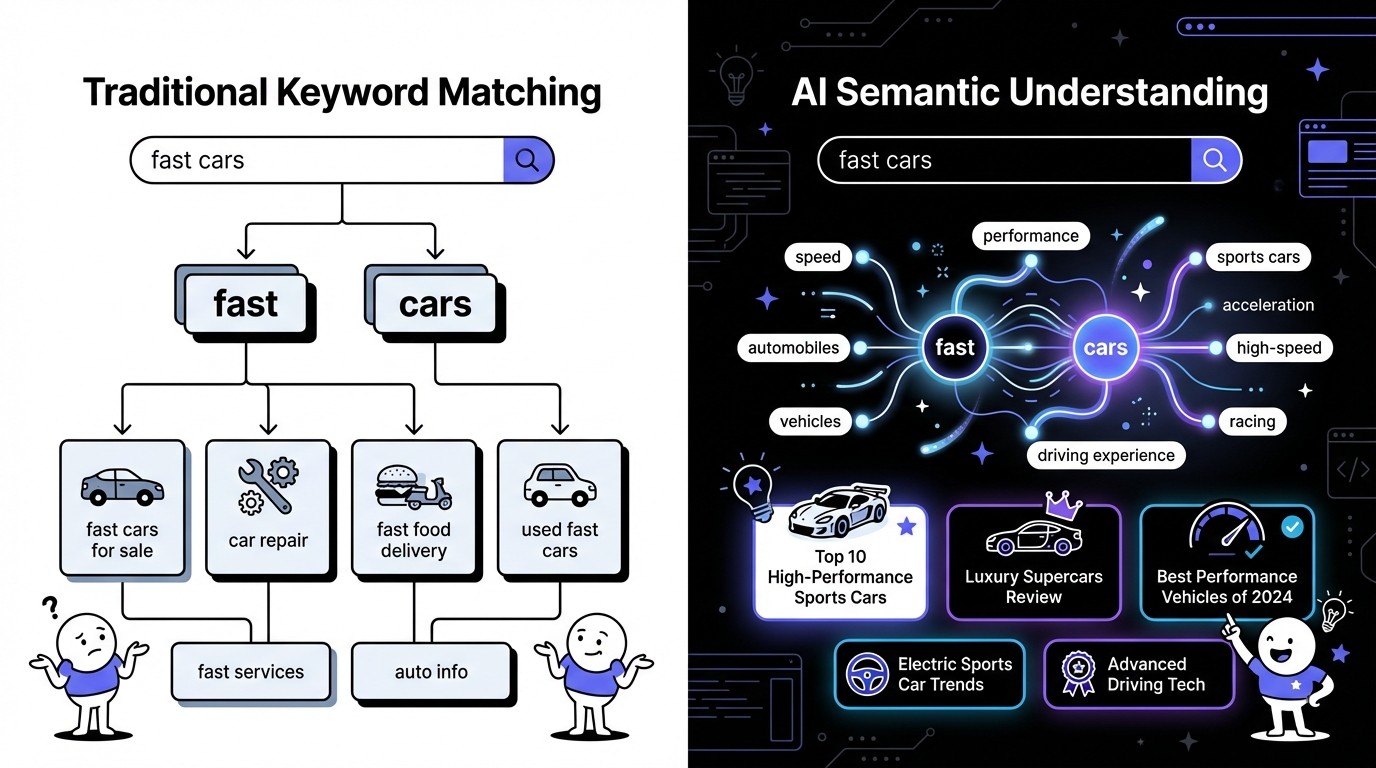
Traditional Keyword Matching vs. AI Semantic Understanding: A Visual Comparison

Visualizing the statistic: nearly two-thirds of a specific group are women.
Key Data & Trends: The Impact of Google SGE, AI Overviews & Reduced Clicks
The shift to AI-driven search isn't a future problem. It's impacting website traffic right now. The data shows a clear and concerning trend for businesses that rely on organic search for leads and customers. The core issue is the rise of zero-click searches, driven by features like Google SGE.
The data paints a stark picture. An early Authoritas analysis found AI Overviews hijacking the top of the results for up to 87% of commercial queries. When that happens, clicks to organic links don't just drop—they plummet. This isn't a new landscape; it's a zero-sum game where your content is now competing directly with Google itself for your audience's attention, profoundly affecting your blog visibility AI.
The New User Journey: From Click to Glance
The way users interact with search results has fundamentally changed. Previously, the goal was to earn a click from a list of links. Now, with Google SGE and similar AI features, the AI often presents a complete answer, making a click unnecessary.
This new path to information bypasses your website entirely.
User JourneyTraditional SearchAI-Driven Search (SGE)User GoalFind the best link to answer a questionGet an immediate answer from AI search enginesInteractionScans links, clicks to read contentReads the AI Overview on the SERPResultWebsite trafficZero clicks, zero traffic, impacting blog visibility AI
This decline in clicks directly impacts your blog visibility AI. If your content isn't a primary source for these AI Overviews, your marketing efforts will generate diminishing returns. The new goal is not to just rank on the page, but to be featured within the AI's answer. This requires a new approach centered on semantic SEO and deep contextual authority.
Decoding AI Search: Semantic SEO, Structured Data & E-E-A-T
You already know the key players: semantic context, structured data, and E-E-A-T. But in the world of Google SGE, their roles have changed. They're no longer separate tactics to check off a list. They are three threads that must be woven together to prove your authority to a machine. Mastering their new synergy is what separates content that gets featured from content that gets ignored by AI search engines.
These elements work together. They provide AI search engines with the signals needed to understand, trust, and feature your content in their generated answers, directly influencing your blog visibility AI.
The Three Pillars of AI-Ready Content
Your content strategy must evolve beyond keywords. It needs to embrace a more holistic approach that satisfies both machine and human readers, a core principle of semantic SEO.
ComponentWhat It IsHow to Implement ItSemantic SEOBuilding deep contextual relevance around a topic, not just a single keyword. This comprehensive approach is the bedrock of effective semantic SEO.Create content clusters. Cover related subtopics, answer adjacent user questions, and internally link between relevant articles to build a knowledge hub.Structured DataA standardized code format (like Schema.org) that explicitly labels your content for search engines.Use schema markup for articles, FAQs, and author information. This tells the AI, "This is the publication date," or "This is the author's name."E-E-A-TA framework for demonstrating Experience, Expertise, Authoritativeness, and Trustworthiness.Include detailed author bios with credentials. Cite original sources and data. Update content regularly to ensure accuracy and relevance.
Why Structured Data is Your Direct Line to the AI
Structured data is especially critical for Google SGE. It removes ambiguity. Instead of forcing an AI to guess what a piece of text means, you label it directly. According to Google's own Search Advocate, John Mueller, structured data helps Google "better understand what the page is about" and can be a very strong signal.
Think of it this way: without structured data, your article is a block of text. With it, your article becomes a database of facts the AI can easily query. This makes your content a prime candidate for inclusion in AI Overviews because the information is verified and simple to process. It significantly boosts your blog visibility AI. Your blog post becomes a reliable source, not just a document.
Your AI Visibility Blueprint: Actionable Strategies for Blog Visibility AI
Understanding the new rules of AI search engines is the first step. Now you must act. Applying the principles of semantic context and structured data will directly improve your blog visibility AI. These strategies shift your focus from simply ranking for keywords to becoming a trusted source for AI.
Implement Semantic SEO: From Keywords to Comprehensive Topic Clusters
AI search engines think in topics, not just keywords. A single blog post, no matter how well-written, rarely demonstrates true expertise. The solution is to build content clusters that cover a subject from every angle. This is the core of practical semantic SEO.
Instead of writing one article on "AI in Marketing," build a hub.
Pillar Page: A comprehensive guide to "The Complete Guide to AI in Marketing."
Spoke Articles: Create specific posts on "Using AI for Email Personalization," "AI-Powered Content Creation Tools," and "Measuring ROI on AI Marketing."
Internal Links: Connect each spoke article back to the pillar page.
This structure proves your authority. It shows Google SGE that you have deep, interconnected knowledge on a subject, making your content a more reliable source for its answers and enhancing your blog visibility AI.
Master Structured Data: Implement Granular Schema Markup
Go beyond basic schema. Think of your website as a miniature knowledge graph. Use schema's @id property to create unique identifiers for your core entities (authors, products, concepts) and the sameAs property to link them to authoritative external sources like Wikipedia or industry profiles. This doesn't just label your content; it explicitly maps out your expertise and connections for the AI, making your authority undeniable to AI search engines.
This deep level of markup pays off. A study by Milestone Research found that content entities with more complete schema appeared in 40% more AI-generated answers, directly impacting blog visibility AI.
StrategyTraditional ApproachAI-Ready BlueprintContent FocusOne-off, keyword-based articlesInterlinked topic clusters, driven by semantic SEOData MarkupBasic article schemaKnowledge graph schema (@id, sameAs), leveraging structured dataAuthor SignalGeneric "By Admin" bylineDetailed author bios with Person schemaContent GoalRank on page oneBecome a cited source in the AI Overview, boosting blog visibility AI
The goal is to make your content a database of verifiable facts, not just a block of text. This structured approach to expertise is exactly what AI search engines need to build trust and feature your content.
The old SEO playbook is gone. AI search engines aren't looking for keywords; they're looking for proof. Building a miniature knowledge graph with structured data, as we outlined, is how you provide that proof. This isn't just about optimization. It's about structuring your expertise so AI search engines choose your content first, greatly enhancing your blog visibility AI. The brands that build this machine-readable authority today will own organic traffic tomorrow, especially as Google SGE becomes more prevalent.
Stop manually optimizing for AI and let our AI do it for you. See how MarketDay automatically generates content that's built to be found by the next generation of AI search engines. Start your free trial.
Visuals
Frequently Asked Questions
What are AI search engines and how do they change blog visibility?
AI search engines understand user intent and content context, rather than just matching keywords. This fundamental shift means your content is no longer just a document to be ranked; it's a potential source for a direct answer. This profoundly impacts your blog visibility AI, requiring your content to be a definitive, comprehensive source.
Why is semantic SEO essential for making content visible to AI search engines?
Semantic SEO is crucial because AI search engines analyze the meaning and context behind your content, connecting concepts and identifying entities. It helps them grasp relationships between topics, moving beyond keyword stuffing to genuine understanding. This approach is vital for your content to be recognized as authoritative, boosting your blog visibility AI.
How do AI search engines differ from traditional keyword-focused search engines?
Traditional search engines primarily matched keywords and focused on density for ranking. In contrast, AI search engines prioritize understanding user intent and content depth through semantic SEO. They aim to provide direct answers and summaries, valuing topic authority and structured data over simple keyword repetition, a core tenet of how AI search engines function.
What is Google SGE and how does it affect blog traffic and visibility?
Google SGE (Search Generative Experience) is an AI-driven feature that provides direct answers and summaries, often as 'AI Overviews,' directly on the search results page. This leads to 'zero-click searches,' where users get answers without visiting your site. For your blog visibility AI, it means your content must be the source for these AI-generated answers to capture attention and traffic.
How does structured data improve content understanding for AI search engines?
Structured data helps AI search engines by explicitly defining the entities and relationships within your content in a machine-readable format. This allows AI to more easily parse, understand, and confidently use your information to generate accurate answers and summaries. Implementing structured data is vital for enhancing your blog visibility AI and ensuring your content is leveraged by AI search engines.
What are zero-click searches and why are they a concern for blog owners?
Zero-click searches occur when users find their answer directly on the search results page, often through features like Google SGE's AI Overviews, without clicking any organic links. This is a significant concern for blog owners because it drastically reduces organic traffic, making it harder to maintain blog visibility AI and engage potential readers who no longer need to visit your site.
How can content creators adapt their SEO strategy for AI search engines?
Content creators must shift from keyword chasing to building topic authority using semantic SEO. Focus on comprehensive, contextually rich content that fully answers user intent, rather than just repeating keywords. Implementing structured data and aiming to be the definitive source for AI-generated answers are key strategies to boost blog visibility AI with modern AI search engines.



Hop on a call with us to see how our services can accelerate your growth.