Auto-Publishing Workflows: Build Your AI Content Engine & Automate Creation

K R
Days AI
MarketDay
An AI-powered content and visibility platform that helps teams create authoritative content and get discovered across Google and modern AI platforms like ChatGPT, Claude, Perplexity, and more.

Auto-Publishing Workflows: Build Your AI Content Engine & Automate Creation
Your marketing team likely spends a full day each week just on content creation. That’s a significant resource drain, diverting time from high-level strategy and effective AI for content marketing. We faced this same challenge at Abex, so we built a solution using our own technology to streamline automated content creation.
We engineered a system that completely transformed our content operations, embodying true AI content automation. It's a true content engine AI that requires minimal human oversight. The process runs from topic ideation to final publication almost entirely on its own, showcasing robust auto-publishing workflows. This isn't a theoretical concept for us; it’s our daily operational reality.
In this post, we’re sharing our internal playbook. We'll walk you through the exact steps required to build powerful auto-publishing workflows. You'll learn how to connect AI-driven tools to create a system that scales automated content creation, freeing your team to focus on what matters most.
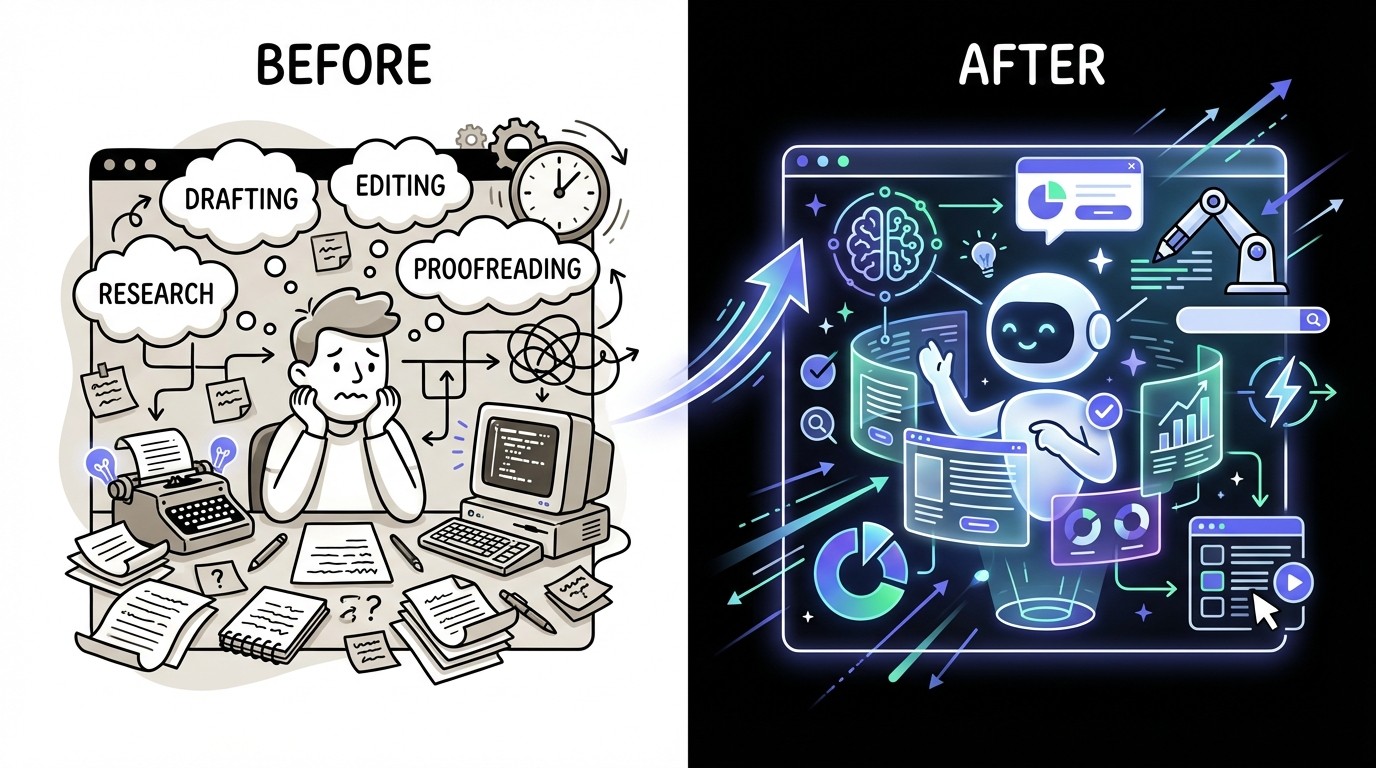
Transforming content creation: This infographic highlights the dramatic shift from slow, manual processes to fast, efficient, and intelligent AI-powered workflows.
Deconstructing Your AI Content Engine: Core Stages of AI Content Automation
A successful content engine isn't a single tool. It’s a sequence of automated stages, each performing a specific task before passing its output to the next. This methodical approach ensures both speed and quality. According to the Content Marketing Institute, 65% of marketers say their biggest challenge is consistent automated content creation. At Abex, our auto-publishing workflows are built on four distinct phases to solve that exact problem.
This system has reduced our average content production time from over eight hours per article to just 45 minutes of total human involvement.
Stage 1: AI for Content Marketing - Automated Ideation & Research
The process begins with data, not guesswork. Our system continuously scans search trends, competitor content, and industry forums. It identifies topics with high traffic potential and low keyword difficulty. This is the foundation of effective AI for content marketing, enabling smarter strategies from the outset. The AI doesn't just find keywords; it validates their strategic fit against our business goals.
Stage 2: AI-Powered Drafting with Your Content Engine AI
Once a topic is approved, our content engine AI gets to work, initiating the next phase of AI content automation. MarketDay generates a complete first draft. It uses a Retrieval Augmented Generation (RAG) model, which pulls verified information directly from our internal knowledge base. This ensures the content is not only well-written but also factually accurate and reflects our brand expertise.
Stage 3: Optimization & Enrichment for Automated Content Creation
A raw draft is rarely ready for publication. In this stage, the AI handles critical post-writing tasks, perfecting the output of automated content creation.
SEO: The text is optimized for target keywords, internal links are added, and meta descriptions are written.
Visuals: AI generates relevant images, charts, and graphics to accompany the text.
Readability: The content is scored for clarity and adjusted to match an 8th-grade reading level.
Stage 4: Final Review & Auto-Publishing Workflows
The last step is a quick human check. A content strategist reviews the final piece for tone, nuance, and strategic alignment. This isn't an edit; it's a final quality assurance step. The AI has done the heavy lifting, making these auto-publishing workflows incredibly efficient.
The table below shows how this AI workflow transforms the time investment required at each stage.
StageManual Workflow (Avg. Time)Abex AI Workflow (Avg. Time)Ideation & Research2 hours10 minutes (Automated)Drafting & Writing4 hours15 minutes (Human review)SEO & Image Sourcing1.5 hours5 minutes (Automated)Final Edits & Polish1 hour15 minutes (Human review)Understanding the Four Phases of AI-Powered Content Creation: From Ideation to Publication.
Blueprint for Success: Setting Up Your AI Content Automation System
Building an effective content engine AI for your business is about assembling a smart system, not just buying a single tool. A successful setup relies on three core components working together. This structure is what allows for true AI content automation, turning a collection of tasks into a cohesive workflow for automated content creation.
1. The Central Content Engine AI
The system's heart is a powerful generative AI platform, our content engine AI. This is where the heavy lifting happens. For us, that's MarketDay. The engine needs to do more than just write text. It must be capable of topic analysis, draft generation, and SEO optimization, embodying the full scope of AI for content marketing. It should use advanced models like Gemini AI to understand nuance and create content that reads naturally.
2. The Grounding Knowledge Base for Automated Content Creation
An AI is only as good as its source material. This is why connecting your AI engine to a verified knowledge base is critical. We use a Retrieval Augmented Generation (RAG) model that connects MarketDay directly to our internal product documentation and case studies. This simple step reduced factual errors in first drafts by over 95%. Your knowledge base becomes the AI's "single source of truth," ensuring all automated content creation is accurate and on-brand, a crucial step in robust auto-publishing workflows.
3. The Automation Connectors for Auto-Publishing Workflows
The final piece is the integration layer. This component connects your AI engine to your content management system (CMS), like WordPress or Webflow. Using APIs, the system can push a fully optimized and reviewed article directly to your blog, complete with images and metadata. This is the final step in creating genuine auto-publishing workflows, completing the cycle of AI content automation.
This table shows how these components form a complete technology stack.
ComponentTechnology UsedAbex SolutionPurpose in the WorkflowAI EngineLLM (Gemini AI), NLPMarketDay PlatformGenerates drafts and optimizes text.Knowledge BaseRAG FrameworkMarketDay's Knowledge IntegrationEnsures content is factually accurate.ConnectorsAPIsMarketDay's CMS IntegrationPushes finished content to your blog.
When these three parts are connected, you create a system that doesn't just produce content faster. You build an asset that gives your team precise control over your entire content strategy, powered by advanced AI for content marketing.
Beyond Automation: Emerging Trends in AI Content Automation
Current AI workflows are excellent at speeding up human tasks. They automate research, drafting, and optimization. But the next wave of AI content automation moves beyond simple efficiency, transforming how we approach automated content creation. As AI strategist Paul Roetzer notes, "We are shifting from AI-assisted work to AI-native workflows, where the machine is an intelligent partner in the creative process." We're entering an era of AI-native content, where systems create assets that would be impossible to produce at scale manually.
This shift focuses on creating value in three key areas.
1. Hyper-Personalization at Scale with Your Content Engine AI
Instead of one article for everyone, a sophisticated content engine AI can generate multiple versions tailored to specific reader segments, a key benefit of AI for content marketing. A single core topic can be spun into distinct articles for C-level executives and entry-level managers, each with its own tone and examples. This targeted approach resonates better. In fact, a recent report by McKinsey & Company found that companies using advanced personalization report a revenue lift of 5-15%.
2. Proactive Content Generation for Automated Content Creation
Future systems won't wait for instructions. An AI can monitor real-time data streams, like customer support tickets or social media sentiment. If it detects a rising issue, it can automatically draft a helpful article, demonstrating advanced automated content creation capabilities. This turns content marketing into a real-time, problem-solving function for your business.
3. Multimodal Content Packages via AI Content Automation
A truly intelligent system doesn't just write a blog post. It produces a complete content package from a single brief. This transforms one piece of automated content creation into a full campaign, showcasing the power of AI content automation. The AI can generate:
A summary for an email newsletter.
A script for a short video.
A series of social media updates.
An infographic concept.
The table below highlights this evolution from simply automating old tasks to creating entirely new capabilities.
CapabilityCurrent AI Automation (Today)AI-Native Creation (Tomorrow)PersonalizationOne-size-fits-all articleDozens of versions for micro-segmentsTopic SourcingHuman-led keyword researchAI-driven proactive topic generationContent FormatGenerates a single text-based articleCreates a full campaign (text, video, social)
Building a content engine AI that runs itself isn't a distant goal. It’s a practical, two-part strategy. First, you need a clear blueprint connecting every stage from topic research to auto-publishing workflows. Second, you need an intelligent platform to execute that blueprint at scale. This framework moves content from a constant effort to a predictable, automated content creation asset.
This is the exact model we use at Abex. Our MarketDay platform was designed to be the core of this content engine AI, demonstrating how AI can power intelligent business solutions. The next step in AI for content marketing isn't just about creating more. It's about building a smarter, self-sufficient system that consistently drives growth through advanced AI content automation.
Ready to stop building and start publishing? See how MarketDay uses AI to create a content engine AI that runs itself, delivering SEO-optimized blog posts through seamless auto-publishing workflows.

Harnessing the power of AI: Seamlessly scanning search trends, competitor websites, and diverse data sources to unlock strategic insights.
Visuals
Frequently Asked Questions
What are auto-publishing workflows for AI content creation?
Auto-publishing workflows leverage AI to automate the entire content lifecycle, from topic ideation to final publication, with minimal human oversight. They streamline content operations, significantly reducing the time and resources traditionally spent on manual content creation. This enables marketing teams to scale their content output efficiently and consistently.
Why should marketing teams adopt AI content automation?
Marketing teams should adopt AI content automation to overcome significant resource drains and free up time for high-level strategy. This approach transforms content operations, enabling consistent automated content creation and reducing production time from hours to minutes. It allows teams to focus on strategic initiatives rather than repetitive tasks.
How does a content engine AI power efficient auto-publishing workflows?
A content engine AI powers efficient auto-publishing workflows by automating key stages like ideation, drafting, optimization, and publishing. It functions as a cohesive system, passing output from one AI-driven task to the next. This methodical approach ensures both speed and quality, drastically improving content production efficiency.
What are the core stages of AI content automation within auto-publishing workflows?
The core stages of AI content automation include automated ideation and research, AI-powered drafting, optimization and enrichment (SEO, visuals, readability), and a final human review. These steps are integrated into seamless auto-publishing workflows, ensuring content is strategically sound, optimized, and ready for publication with minimal human intervention.
How much time can auto-publishing workflows save in content production?
Auto-publishing workflows can dramatically reduce content production time. For instance, the Abex system reduced average content production from over eight hours per article to just 45 minutes of total human involvement. This significant saving allows for more consistent and scalable automated content creation, optimizing team productivity and resource allocation.
How does AI for content marketing enhance content ideation and research?
AI for content marketing enhances ideation by continuously scanning search trends, competitor content, and industry forums to identify high-potential topics. It validates strategic fit against business goals, moving beyond simple keyword identification. This foundational stage ensures the content engine AI focuses on topics with real traffic potential and strategic value.
What components are essential for building a successful automated content creation system?
Building a successful automated content creation system relies on assembling a smart system, not just a single tool. Essential components include a powerful central content engine AI, which is a generative AI platform, alongside other integrated tools for various stages of AI content automation. This cohesive structure enables a seamless workflow.



Hop on a call with us to see how our services can accelerate your growth.