Mastering SEO Blog Posts: AI-Powered Ranking & E-E-A-T Strategy

K R
Days AI
MarketDay
An AI-powered content and visibility platform that helps teams create authoritative content and get discovered across Google and modern AI platforms like ChatGPT, Claude, Perplexity, and more.

Mastering SEO Blog Posts: AI-Powered Ranking & E-E-A-T Strategy
The SEO playbook is changing fast. As we look toward 2026, the gap between high-ranking content and everything else will widen, making a robust AI for SEO strategy essential. The reason? A new collaboration between human experts and AI, especially as Generative Engine Optimization becomes paramount. Generic, AI-spun articles are flooding the internet. Google’s algorithms now identify and penalize this low-value content, leaving marketing teams at a crossroads.
The answer isn’t to abandon AI. It's to implement what we call the Amplified Expertise Model. This guide provides a clear roadmap for creating the kind of SEO blog posts 2026 will reward, focusing on quality and relevance. We will explore how to build E-E-A-T AI content that satisfies Google's stringent E-E-A-T guidelines by using AI as a powerful research amplifier, not a robotic author. The goal is to produce work that is genuinely helpful and authentically human, powered by intelligent technology that scales your team's unique knowledge.
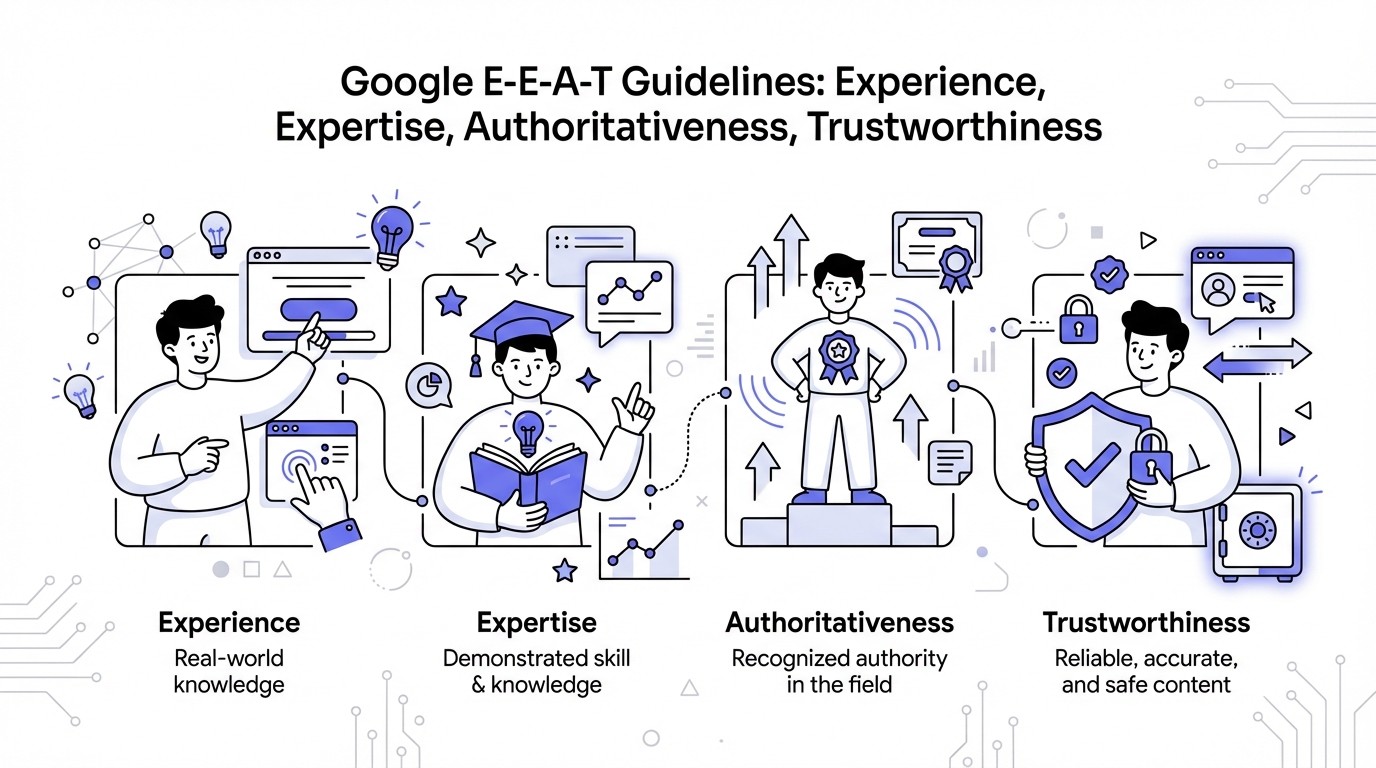
Demystify Google's E-E-A-T guidelines with this clear, modern infographic, illustrating the core principles of Experience, Expertise, Authoritativeness, and Trustworthiness for high-quality content.
Mastering Topic Clusters with AI: A Core AI for SEO Strategy
Focusing on single keywords is a losing game. Search engines now prioritize content that shows comprehensive expertise on a subject. This is where topic clusters become essential. They signal to Google that you're an authority on an entire domain, not just one search term.
Building these clusters manually is slow and difficult. An effective AI for SEO strategy uses AI to perform this complex analysis instantly. Advanced platforms can map an entire topic, identifying dozens of related subtopics and questions users are asking. This moves you from guessing what to write next to building a data-driven content plan.
Building Your Authority Map: The Foundation for E-E-A-T AI Content
Think of it as creating an authority map. You have one central "pillar" page on a broad topic. It's supported by multiple "cluster" pages that explore specific subtopics in detail. Each cluster page links back to the pillar, creating a powerful network of internal links that builds high-quality E-E-A-T AI content.
HubSpot's research confirmed the power of this model. After implementing topic clusters, they increased their monthly organic search views by over 50% in just one year. AI makes this strategy accessible to any team.
For instance, for a pillar page on the broad topic of "AI for SEO Strategy," an AI-powered tool might instantly identify essential cluster topics your audience is searching for, such as:
"Using AI for Competitor Content Gap Analysis"
"E-E-A-T AI Content Editing Checklist"
"Prompt Engineering for High-Ranking Blog Posts"
"Measuring the ROI of AI in Your Content Workflow"
FeatureTraditional Keyword ApproachAI-Powered Topic Cluster ApproachCore GoalRank for one specific term.Dominate an entire topic area.Content StructureIsolated, disconnected articles.A central pillar page linked to many related cluster pages.AI's RoleGenerate keyword-stuffed text.Map semantic relationships, identify content gaps, and inform AI content ranking.Expected OutcomeVolatile, short-term rankings.Sustainable authority and strong E-E-A-T signals.
With a clear topical map built by AI, your team can focus its energy on producing content that builds true authority, making your SEO blog posts 2026 stand out. You're no longer just answering a query; you're creating the definitive resource.

Unleashing the power of AI: Transforming complex data into actionable insights with advanced analytical capabilities.

Visualizing a Topic Cluster: Central Pillar Topic and Interconnected Sub-Topics
Crafting 'Source-Worthy' Content for Generative AI (GEO)
The goal of SEO is shifting. Ranking on a list of blue links is no longer enough. The new top position is inside the AI-generated answer itself. This is the core of Generative Engine Optimization (GEO). Your content must become a trusted, citable source for AI models.
When an AI cites your blog post, it’s a powerful endorsement. It validates your expertise directly to the user. This drives high-intent traffic from people who see you as the authority. It's a critical factor for long-term AI content ranking and a key outcome of successful Generative Engine Optimization.
Verifiable Facts: The E-E-A-T Foundation for SEO Blog Posts 2026
AI models are trained to find and synthesize verifiable information. Generic content gets ignored. To create E-E-A-T AI content that gets cited, you must embed unique value that a machine can trust.
This requires a clear strategy:
Include Original Data & Insights: Don't just report on industry trends—create them. For example, a SaaS company can analyze anonymized usage data to publish a unique statistic like, "Our data shows that teams using feature X complete projects 30% faster." This transforms internal knowledge into a powerful, citable fact that AI models are primed to reference.
Cite Primary Sources: Link directly to academic papers or government reports.
Add Expert Quotes: Feature insights from your internal team of specialists.
Use Structured Data: Implement Schema markup to clearly label facts for search engines.
A 2024 BrightEdge study found that over 80% of AI search overviews cite their sources. This makes creating verifiable, data-rich content a non-negotiable strategy for SEO blog posts 2026.
The Human Touch: Building E-E-A-T AI Content Ethically
An AI can generate a draft. It cannot share a lesson learned from a decade of experience. This distinction is the key to creating content that achieves high AI content ranking. Google’s helpful content systems reward content showing deep, first-hand expertise. Relying on AI for full automation is a direct path to creating generic content that algorithms and readers ignore.
Consider this practical example:
AI-Generated Draft (Lacks Experience): "Using AI for SEO is an effective strategy. It can help with keyword research and content creation, which saves time for marketing teams and can improve search rankings."
Human-Expert Enhanced Version (Adds E-E-A-T): "While AI excels at keyword research, our team learned the hard way that relying on it for final content can backfire. In Q3 of last year, we saw a 15% drop in rankings for a key blog cluster after publishing AI-only drafts. We discovered the content lacked specific examples from our own client work. Now, our process requires an expert to add a unique case study or proprietary data point to every post. This simple step not only recovered our rankings but increased time-on-page by 40%."
The most effective AI for SEO strategy is about augmentation, not replacement. AI handles the heavy lifting—research, structure, the initial draft. Your subject matter expert provides the irreplaceable human element: the unique perspective, hard-won insights, and final verification. This is how you build genuine E-E-A-T AI content.
Human-Led, AI-Assisted: The Workflow for Top AI Content Ranking
This partnership model already defines top-performing content teams. A 2024 survey by the Content Marketing Institute found that 75% of high-performing B2B content teams use AI for assistance, not full automation. They recognize that human oversight is essential for building trust and authority.
A human-led approach transforms a generic draft into an asset that drives AI content ranking.
ElementAI-Only ContentHuman-Led (AI-Assisted) ContentExperienceGeneric, lacks personal perspective.Includes unique anecdotes and case studies.ExpertiseMay contain factual errors or lack nuance.Fact-checked and enriched by a subject matter expert.TrustFeels impersonal and can erode reader trust.Builds credibility with an authentic voice and clear authorship.Ranking SignalOften flagged as low-value, hindering AI content ranking.Aligns with E-E-A-T, signaling high quality for strong AI content ranking.
This collaborative process is the most reliable way to produce SEO blog posts 2026 that satisfy both search algorithms and human readers. AI provides the blueprint. You are the architect.
AI Tools for SEO Content: A Key AI for SEO Strategy from Brainstorm to Optimization
An effective AI for SEO strategy depends on applying the right tools at each stage of the content lifecycle. It’s not about one single action. It’s a complete workflow where AI assists human expertise from the initial idea to the final publication. This partnership turns a slow, manual process into an efficient content engine.
The process begins before you write a single word. AI platforms excel at identifying high-potential topics. They analyze SERP data, competitor content, and user forums to find gaps your audience cares about. This data-driven approach removes guesswork from your content calendar.
A Phased Approach: Optimizing SEO Blog Posts 2026 with AI
Once a topic is chosen, AI helps structure and draft the content. Platforms like MarketDay generate a comprehensive, SEO-optimized outline. They can then produce a first draft that incorporates target keywords, follows best practices for readability, and even integrates facts from a secure knowledge base.
This AI-generated foundation is a massive time-saver. HubSpot's 2024 State of Marketing report found that marketers save an average of three hours per blog post by using AI. That time is now free for your experts to add the unique insights and authentic experience that drive AI content ranking.
The table below breaks down this collaborative workflow:
Content StageAI's Role (The Assistant)Human's Role (The Strategist)IdeationAnalyzes data to find topic gaps and keywords, informing your AI for SEO strategy.Vets topics for strategic fit and audience relevance.DraftingGenerates a structured, SEO-focused first draft, laying the groundwork for E-E-A-T AI content.Enriches the draft with unique expertise and anecdotes.OptimizationChecks for readability, keyword density, and internal link opportunities, crucial for AI content ranking.Performs a final fact-check and ensures brand voice consistency.PublishingCreates meta descriptions and suggests social media copy.Approves the final piece and monitors its performance, ensuring long-term success for SEO blog posts 2026.
This structured model ensures you produce high-quality SEO blog posts 2026 at scale. AI handles the repetitive tasks, allowing your team to focus on creating genuinely valuable content.
The path to ranking with SEO blog posts 2026 is clear. Success no longer comes from chasing individual keywords. It comes from building deep topic authority and becoming a citable source for generative AI engines, a core aspect of Generative Engine Optimization. This pivot demands a new partnership between creator and machine to achieve optimal AI content ranking.
Your expertise remains the core of E-E-A-T, forming the backbone of truly valuable E-E-A-T AI content. AI's role is to amplify that knowledge, not replace it, as part of a comprehensive AI for SEO strategy. The next step is to review your own content workflow. Find the places where a human expert can transform a generic statement into a powerful, experience-driven insight, just like in the "before and after" example. That is the key to building the trust that both algorithms and audiences will reward.
See how MarketDay helps you implement the Amplified Expertise Model to create content that ranks. Explore a free trial to learn more.

Bridging human insight with artificial intelligence. Pioneering the future of collaboration.
Visuals



Hop on a call with us to see how our services can accelerate your growth.