Salesforce vs. Lightweight CRM for AI Startups: Which Is Right for You?

K R
Days AI
SalesDay
An AI sales acceleration system that identifies high-intent prospects, automates outreach, and optimizes follow-ups to increase conversions.

Salesforce vs. Lightweight CRM: AI Startups' Founder's Guide
Your AI company turns data into intelligence. Why run your growth engine on a CRM that can't keep up? The classic debate—Salesforce versus a lightweight alternative—is more urgent than ever for tech founders. The choice is no longer just about features versus cost. For AI startups, you must find a system that handles the unique demands of an AI-driven business, aligning with evolving AI-powered CRM trends.
The right CRM acts as an extension of your product. It integrates with your AI models, automates complex customer interactions, and provides the clean data your algorithms need to learn. This critical CRM integration AI ensures your customer data fuels innovation. The wrong choice creates friction, slows your sales cycle, and turns customer data into a liability.
This guide cuts through the noise. We'll analyze the pros and cons of using Salesforce for AI startups, weighing its powerful ecosystem against its complexity. We will then compare it to the agility of modern, lightweight CRM for startups. You'll get a clear framework for choosing the platform that scales with your business, not against it, forming a robust startup CRM strategy.
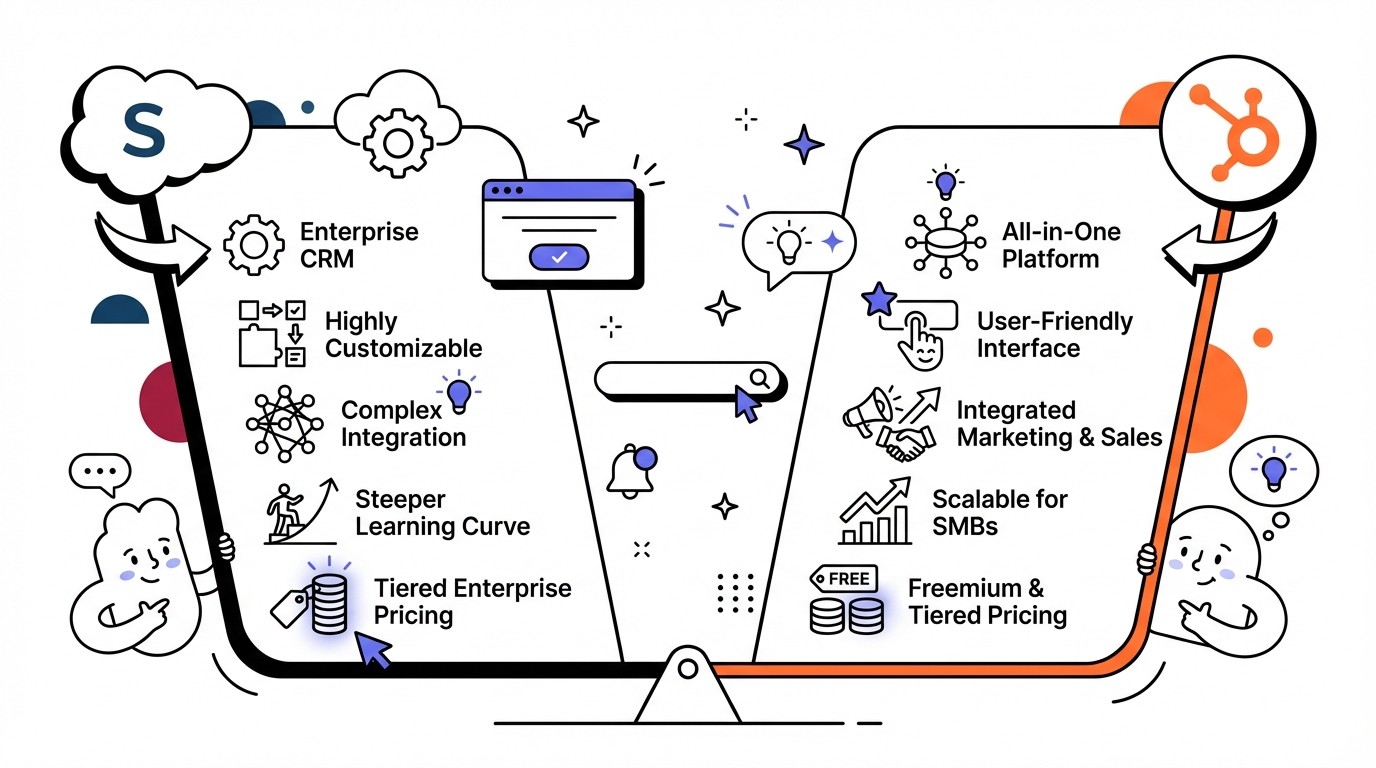
Salesforce vs. HubSpot: A Side-by-Side Comparison of Leading CRM and Marketing Automation Platforms.
Salesforce for AI Startups: Robust Ecosystem for Enterprise Growth
For many founders, Salesforce suggests complexity and high costs. That perception isn't entirely wrong. For an AI company with enterprise ambitions, however, that complexity is a feature, not a bug. It’s an investment in a foundation built for massive scale, positioning Salesforce for AI startups as a long-term solution aiming for significant growth and leveraging advanced AI-powered CRM trends.
Salesforce is more than a sales tool; it's an operating system for customer data. Its real power for an AI-centric business is its mature ecosystem and deep customization. The AppExchange, for instance, offers over 7,000 apps. Your team can plug in specialized data enrichment or analytics tools, feeding your AI models cleaner information without building everything from scratch, a key aspect of effective CRM integration AI.
This level of control is critical for effective CRM integration AI. An AI company providing a text-to-video generation tool could create a custom Salesforce object called AI Usage. This object could track fields like Monthly_Credits_Used, Average_Render_Time_Seconds, and Last_Feature_Accessed (e.g., 'Character Animation'). Correlating this data with renewal rates becomes a simple reporting exercise, demonstrating the power of Salesforce for AI startups in managing product-specific data.
Choosing this path means you're preparing for where your company is going, not just where it is today. The platform's own capabilities, like its Einstein AI, also reflect broader AI-powered CRM trends, giving you access to predictive tools within the ecosystem.
Here’s a breakdown of the strategic trade-offs for a growing AI startup:
AspectPro for AI StartupsCon for AI StartupsEcosystem & IntegrationAccess thousands of apps on the AppExchange for specialized data and analytics, enhancing CRM integration AI capabilities.Can lead to "app overload" and significant increases in subscription costs.Deep CustomizationBuild custom objects and workflows that mirror your unique AI product metrics.Requires a dedicated administrator or developer to manage effectively.ScalabilityA platform engineered to handle enterprise-level data volume and user complexity, making it a strong choice for Salesforce for AI startups with ambitious growth.Can be overkill for small teams, leading to payment for unused capacity.Data GovernanceEnforces structured data entry, providing cleaner fuel for machine learning models, a key advantage for Salesforce for AI startups focused on data quality.The rigid structure can feel restrictive compared to more flexible, modern CRMs.
Opting for Salesforce for AI startups is a bet on your future growth. It demands a significant upfront investment of time and money. Yet, for founders aiming to sell into the enterprise, building on a platform your future customers already trust provides a powerful strategic advantage for your startup CRM strategy, aligning with sophisticated AI-powered CRM trends.
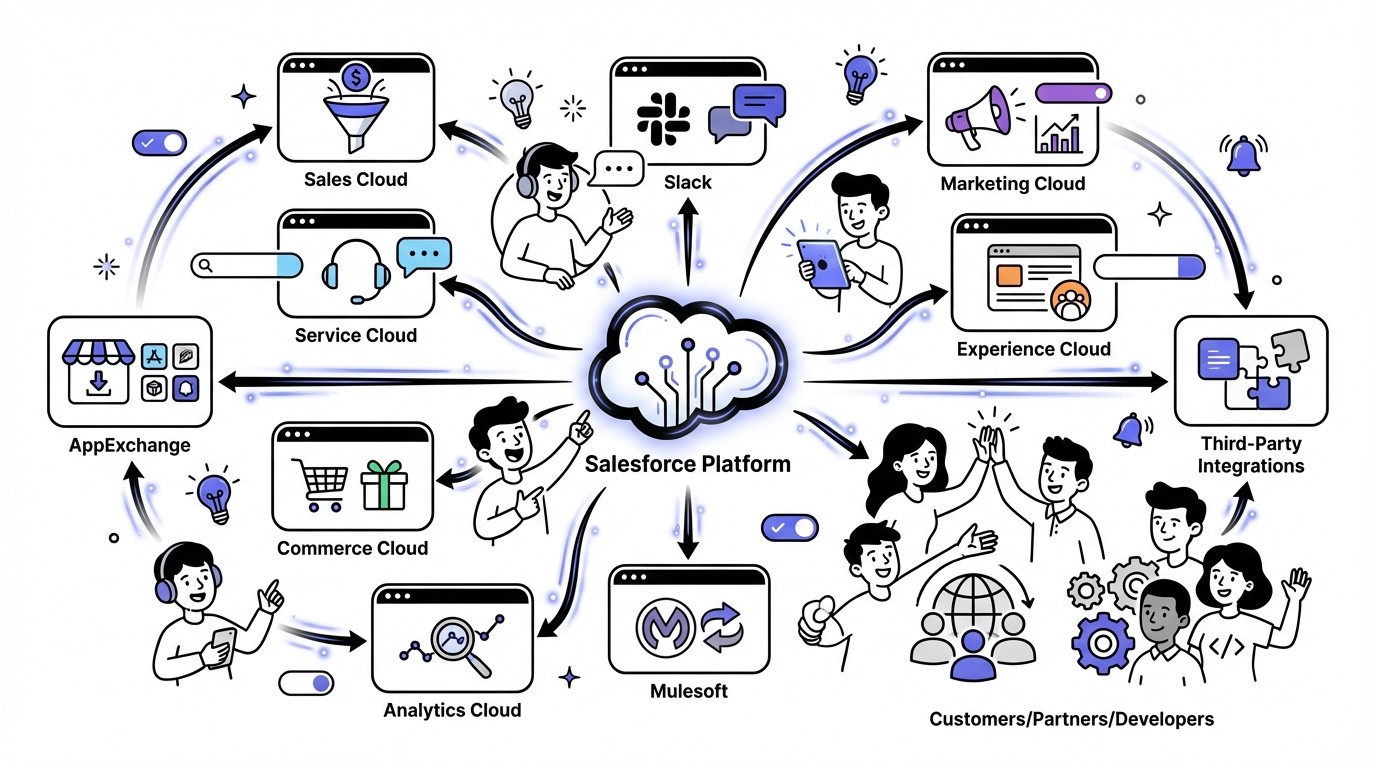
Visualizing the Salesforce Ecosystem: A comprehensive diagram showcasing the Salesforce Platform as the central hub, seamlessly integrating various clouds, AppExchange solutions, and external integrations to empower customers, partners, and developers.
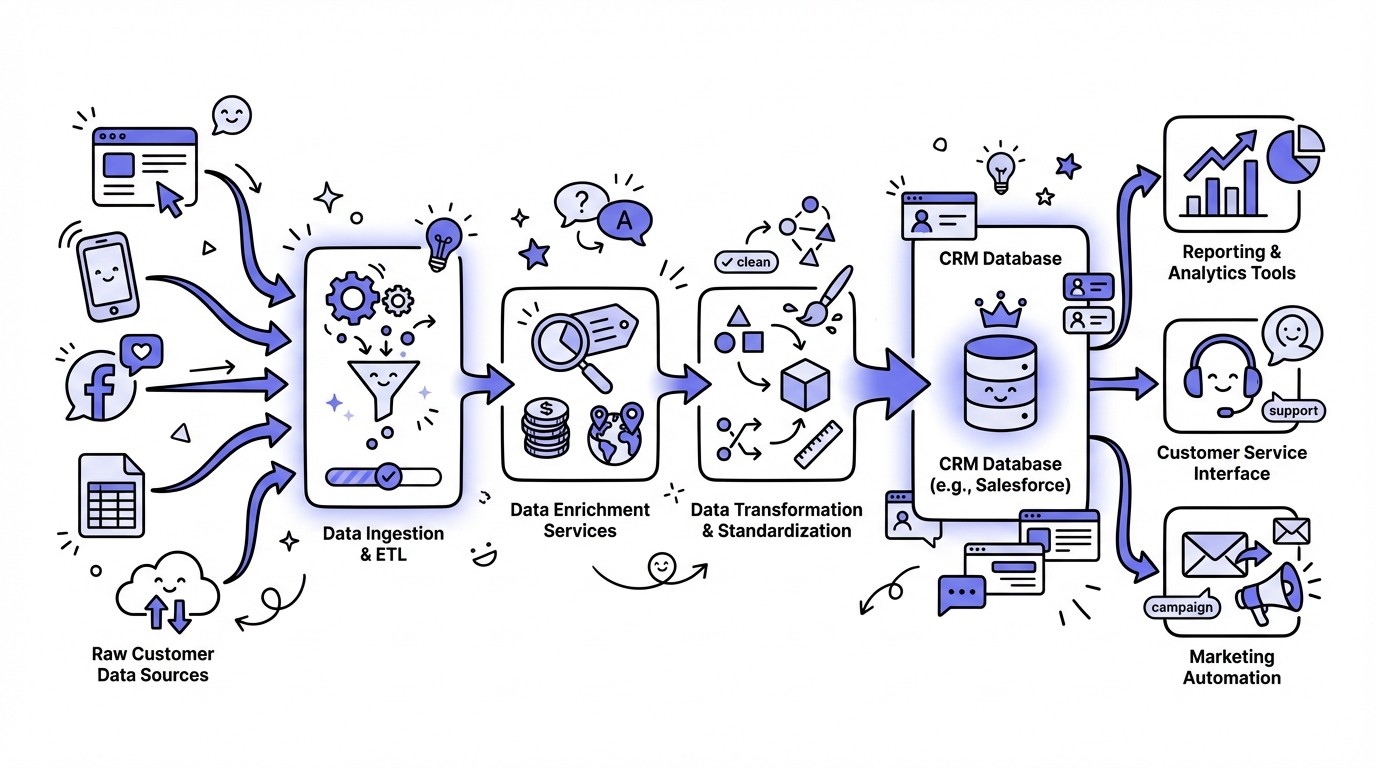
This data flow diagram illustrates the comprehensive journey of raw customer data, from diverse sources through crucial enrichment and transformation stages, into a centralized CRM system like Salesforce, enabling robust reporting and customer engagement.
Lightweight CRM for Startups: Agility & Focus for Rapid AI Ventures
While Salesforce prepares you for an enterprise future, lightweight CRM for startups like HubSpot, Pipedrive, or Copper help you win today. For most startups, speed is the most valuable asset. A nimble CRM prioritizes rapid implementation and user adoption, allowing your team to focus on building and selling, not on system administration. This approach is central to a modern startup CRM strategy.
The primary advantage is simplicity. Your team can be up and running in hours, not months. Such speed is crucial for an AI company where product features and sales motions change quickly. Instead of fighting with a rigid system, a lightweight CRM for startups adapts to your process. As a result, your sales and marketing teams spend their time on revenue-generating activities, not on complex data entry protocols.
Modern lightweight CRMs are also built with an API-first philosophy, a design perfect for CRM integration AI. Your engineers can connect a product usage database to the CRM in a single afternoon. This setup lets your sales team see exactly which customers are using your new generative AI features, providing timely data for upsell conversations. This direct, flexible data access is often faster than navigating the complex object models of larger platforms, making it an ideal lightweight CRM for startups that prioritize agility and real-time insights, reflecting current AI-powered CRM trends.
Here’s how a lightweight CRM stacks up for a fast-moving AI startup:
AspectLightweight CRM AdvantagePotential DrawbackImplementation SpeedGo live in days or even hours, with minimal training required.May lack the deep, industry-specific configurations needed for regulated markets.User AdoptionThe intuitive interface encourages consistent use by the entire team.Fewer built-in automation rules may require more third-party tools like Zapier.Flexibility & APIsEasily connect to your proprietary AI tools and data sources, facilitating advanced CRM integration AI.Can become disorganized without a clear data strategy as the company scales.Cost StructurePay-as-you-grow pricing models align with a startup’s budget.Per-user costs can add up quickly during periods of rapid team growth.
Choosing a lightweight CRM for startups is a vote for agility. It’s a tool designed for iteration and immediate impact. This approach allows your CRM to evolve with your business, ensuring your customer data supports your growth instead of slowing it down, a key component of an effective startup CRM strategy.
Key Decision Factors for AI Founders: Scalability, CRM Integration AI, and Budget for Your AI Startup CRM
The choice between Salesforce and a lightweight CRM isn't just about features. It’s about matching a platform to your company's growth trajectory and technical needs. Your decision should be guided by three core factors: your scalability timeline, your AI integration model, and your true budget, all crucial for your startup CRM strategy.
Scalability: Planning Your AI Startup's 18-Month CRM Horizon
Think about where your business will be in 18 months. If you’re targeting enterprise clients with long sales cycles, a platform like Salesforce provides a predictable foundation for that scale. Its structure is designed to handle complexity from the start, a common requirement and benefit for Salesforce for AI startups.
Conversely, if your growth is less predictable and more experimental, a lightweight CRM for startups offers agility. You can adapt quickly without being locked into a complex system. Your team won't be slowed down by a tool built for a company you haven't become yet, making it a flexible choice for your startup CRM strategy.
CRM Integration AI: Building Your Data Pipeline
For an AI company, CRM integration AI is the most critical factor. Your CRM must effectively manage proprietary data from your AI models and products.
Salesforce for AI startups excels at creating structured data environments with custom objects. This is ideal for feeding clean, organized data sets into your own machine learning models for analysis, a key benefit for robust CRM integration AI.
Lightweight CRMs for startups typically use a flexible, API-first approach. This allows engineers to quickly connect real-time product usage data, giving your sales team immediate insights into customer behavior. This approach is central to modern AI-powered CRM trends and simplifies CRM integration AI for dynamic product environments.
Total Cost of Ownership (TCO) for Your AI Startup CRM
Look beyond the monthly license fee. The initial cost of a CRM is often just a fraction of its total expense. Poor data quality alone costs U.S. companies an estimated $3.1 trillion annually, according to an IBM study. Choosing the right system from the start prevents these hidden costs, especially when considering your startup CRM strategy.
Salesforce often requires expensive implementation partners and a dedicated administrator, impacting the TCO for Salesforce for AI startups looking for a comprehensive solution. A lightweight CRM for startups has a lower initial cost, but expenses can grow as you add users and rely on third-party tools for automation, a factor to weigh in your startup CRM strategy.
Here’s how the two approaches compare across these key decision points:
Decision FactorSalesforce ApproachLightweight CRM ApproachScalabilityBuilt for predictable, enterprise-level growth, ideal for Salesforce for AI startups.Designed for agile, unpredictable scaling, a core benefit of a lightweight CRM for startups.AI IntegrationStructured data via custom objects for clean ML inputs, supporting advanced CRM integration AI.Flexible APIs for fast, real-time product data feeds, aligning with AI-powered CRM trends and easy CRM integration AI.Total CostHigh upfront license and implementation costs, a significant investment for Salesforce for AI startups in their startup CRM strategy.Lower initial cost with potential for rising integration fees, a key consideration for lightweight CRM for startups and their startup CRM strategy.
Your startup CRM strategy ultimately depends on your vision. Are you building a structured enterprise machine or a fast, adaptable product-led engine? The right CRM will accelerate that vision, not complicate it.
Your CRM is your growth engine. For an AI company, this decision is about both data and intelligence. Whether you choose the structured data environment of Salesforce for AI startups or the API-first flexibility of a lightweight CRM for startups, you're building the hub that connects your product insights to your revenue pipeline, all while staying ahead of AI-powered CRM trends and optimizing for robust CRM integration AI.
The right choice supports your specific AI roadmap. It creates a foundation for intelligent growth. Once that foundation is in place, the next challenge is filling your pipeline with qualified leads from AI-driven marketing efforts, like the content generated by MarketDay.
Don't just manage your pipeline—supercharge it with a steady stream of qualified leads. Discover how MarketDay's AI automatically writes the SEO-optimized content that fills your new CRM.
Visuals


Hop on a call with us to see how our services can accelerate your growth.